
Further reading: accounts and works on the same theme
Accounts and works around this subject, in date order, to place our titles in context. Each links to a free online edition when one exists, or to our own page when the work is in our catalogue.
-
Ogier Ghiselin de Busbecq, Lettres turques (1581)
The imperial ambassador to Istanbul publishes his four Latin letters from the court of Suleiman the Magnificent in 1581. A hundred and eighty years after Schiltberger, the same Ottoman empire, more powerful than ever, receives another Westerner, this time an ambassador. Busbecq describes the Sublime Porte at its height, in the very years when the Frankfurt printer republishes the Bavarian's account for his contemporaries as a cautionary tale. Reading Busbecq right after Schiltberger means following the Ottoman Empire from its childhood to its zenith.
-
Jens Munk, Navigatio Septentrionalis (1624)
In 1619, King Christian IV of Denmark sent Jens Munk in his turn to seek the passage through Hudson Strait. His two ships, the Unicorn and the Lamprey, entered the bay near Digges Island, where Hudson's mutineers had fallen into an ambush, then wintered at the mouth of the Churchill River. Scurvy carried off almost the whole crew: by the spring of 1620, out of more than sixty men, only Munk and two companions were still alive. The three of them brought the Lamprey back to Norway and reached Copenhagen at Christmas. His Navigatio Septentrionalis, published in 1624, ranks among the most terrible accounts of an Arctic wintering, and echoes the winter Hudson had imposed on his men.
Our edition → -
Thomas James, The Strange and Dangerous Voyage of Captaine Thomas James (1633)
In May 1631, Thomas James left Bristol aboard the Henrietta Maria to take up the quest where Hudson had left it. In the bay he met another seeker of the passage, Luke Foxe, who had sailed from London the same season, then headed south, into the bottom of the bay where Hudson had wintered and which today bears the name of James. He spent the winter on Charlton Island, deliberately sank his ship to save it from the ice, refloated it in the spring and returned to Bristol in October 1632. His Strange and Dangerous Voyage, published in 1633, tells of hunger, cold and prayer, and reaches the same conclusion as Hudson's journals: that way, no passage opens toward Asia.
Read a free edition → -
Abel Tasman, Journal de voyage (1643)
In 1643, the Dutch navigator is the first to reach the islands he names Amsterdam and Middelburg, that is Tongatapu and Eua, a hundred and thirty-four years before Cook. His journal, brief and wary, notes the bartering, the canoes, the deceptive gentleness of the welcome. To read it again before this volume is to take the measure of what Cook finds unchanged and of what he comes to understand beyond it: where Tasman saw only a welcoming coast, Cook untangles a kingship, a taboo, an empire of islands.
-
Adam Olearius, Voyage en Moscovie, Tartarie et Perse (1647)
The diplomat from Holstein publishes in 1647 his account of the 1633-1639 journey through Moscow, the Volga, the Caspian Sea, Isfahan, and back by way of Baku. Two hundred years after Schiltberger, the same Siberian, Caucasian, and Persian geography, but under different rulers: the Romanovs in Russia, the Safavids in Persia, the Ottomans in the Caucasus. Schiltberger had seen these roads amid the disorder of Tatar successions; Olearius sees them consolidated into modern empires.
-
Friedrich Martens, Spitzbergische oder Groenlandische Reise-Beschreibung (1675)
In the spring of 1671, the Hamburg barber-surgeon Friedrich Martens shipped aboard a whaler, the Jonas im Walfisch, bound for Spitsbergen. Sixty years earlier, the whales reported by Hudson in 1607 had drawn English and Dutch fleets into these bays; Martens found an established industry there, with its boats, its harpoons and its try-works. While the crew hunted, he observed: the ice breaking away from the glaciers, the polar bear, the walrus, the seabirds, and the scurvy grass, the same plant the survivors of the mutiny gathered on the islands of the bay. His Reise-Beschreibung, printed in Hamburg in 1675, was translated into Italian, Dutch and English.
Read a free edition → -
Jasper Danckaerts, Journal of Jasper Danckaerts, 1679-1680 (1679-1680)
In 1679, two Dutch travellers belonging to the Labadist sect, Jasper Danckaerts and Peter Sluyter, landed in New York in search of land on which to found their community. Seventy years after Hudson's passage, New Amsterdam had become English, but Dutch was still spoken there. Danckaerts travelled through Manhattan, Long Island and New Jersey, went up the river as far as Albany, and noted everything: the farms, the taverns, the Indians still living on the edges of the villages, the quarrels between the churches. Rediscovered in Amsterdam in the nineteenth century and published in 1867, his journal shows what had become, in two generations, of the country whose shores, encounters and skirmishes Juet had described.
Our edition → -
Engelbert Kaempfer, Amœnitates exoticæ (1712)
The physician and naturalist from Westphalia crosses Russia, Safavid Persia, and the Caspian Sea in 1683-1685. His scientific Latin from the close of the seventeenth century offers the first complete European portrait of modern Persia. Where Schiltberger bore first-person witness to Timurid destruction, Kaempfer describes Iran rebuilt under Shah Abbas, with its gardens, its mosques, its caravanserais.
-
Joseph Pitton de Tournefort, Relation d'un voyage du Levant (1717)
The Sun King's French botanist publishes in 1717 his account of the 1700-1702 mission to Anatolia, Georgia, Armenia, and Constantinople. The same places as Schiltberger, exactly three hundred years later, seen through the eyes of a scholar of the nascent Enlightenment. The Caucasus and Anatolia have changed Ottoman rulers, but the names of the cities, the peoples, the religions are much as the Bavarian had seen them.
-
Lorenz Lange, Journal de la résidence du sieur Lange, agent de Sa Majesté impériale de la Grande Russie à la cour de la Chine, dans les années 1721 et 1722 (1726)
When the embassy leaves in March 1721, Unverzagt stays in Peking with the resident Lorenz Lange, and it is the continuation of that stay that Lange's journal recounts, published in French at Leiden in 1726, then translated into English as an appendix to John Bell's account. The tsar's only representative at court, Lange records his visits to ministers, the evasive replies, the trade soon suspended and the affair of the Mongol defectors that blocks everything. Here is Unverzagt's city again, but seen from the files: the patient, often bitter reverse side of the banquets and the New Year fireworks.
Read a free edition → -
Pierre Louis Maupertuis, La figure de la Terre (1738)
In 1736 the Academy of Sciences sends Maupertuis to measure a degree of meridian under the Arctic Circle, in the Tornio valley that Scheffer had known only through letters. The account mixes triangulation, white summer nights, reindeer and ice: Lapland ceases to be an object of erudition and becomes a laboratory. Read it to see the Sámi country enter modern science, two generations after the Lapponia.
Our edition → -
Pehr Kalm, Travels into North America (1753-1761)
A pupil of Linnaeus, the Swede Pehr Kalm set out for North America in 1748, charged with bringing back useful plants. On 10 June 1749, he left New York on one of the river's merchant sloops and sailed up the Hudson to Albany, arriving on the morning of the 13th. He describes the Highlands drowned in mist, the sturgeon leaping out of the water, the tide rising well beyond Albany, the red cedar boats loaded with timber, flour and furs, and wonders about this river that cuts straight through the mountains. His account, published in Stockholm from 1753 to 1761, retraces the ascent of 1609 as a naturalist, with a fresh eye on the same landscape.
Read a free edition → -
John Bell, Travels from St. Petersburg in Russia, to Diverse Parts of Asia (1763)
Unverzagt's best reading companion walked at his side: the Scottish physician John Bell belonged to the same Izmailov embassy. He published his account in Glasgow in 1763, more than forty years after the journey, with the hindsight of a man who had already followed the Russian mission to Persia. In it we find Tobolsk, Lake Baikal, the Mongolian steppe, the entry into Peking and Kangxi's audiences, told by an adult attentive to plants, peoples and the negotiators' arguments. To read the two books together is to see the same procession through two pairs of eyes: the dazzled young man's and the observant practitioner's.
Read a free edition → -
Louis-Antoine de Bougainville, A Voyage round the World (1768)
In April 1768, the Boudeuse anchors off Tahiti, which Bougainville names New Cythera and leaves after nine days, leaving behind anchors and a legend. His account, written by a gentleman-philosopher, single-handedly invents the Polynesian myth that will occupy Europe for a century. To read it before this volume is to measure the distance between the dream and the inquiry: where Bougainville sees an island of gentleness, Cook and Anderson count ranks, wars, the skulls of the morai. The anchor bought back at Bora Bora is the thread linking the two books.
-
Georg Forster, A Voyage round the World (1772-1775)
Son of the naturalist embarked on the second voyage, Forster is seventeen when he discovers Tahiti and the Society Islands. His account, published in 1777, the very year this volume is set in, is the first great literary text to come out of Cook's voyages: sensitive prose, at times indignant, alert to what the arrival of Europeans destroys. He describes the same beaches, the same chiefs, the same war fleet, but through the eyes of an adolescent who refuses to be merely a witness.
-
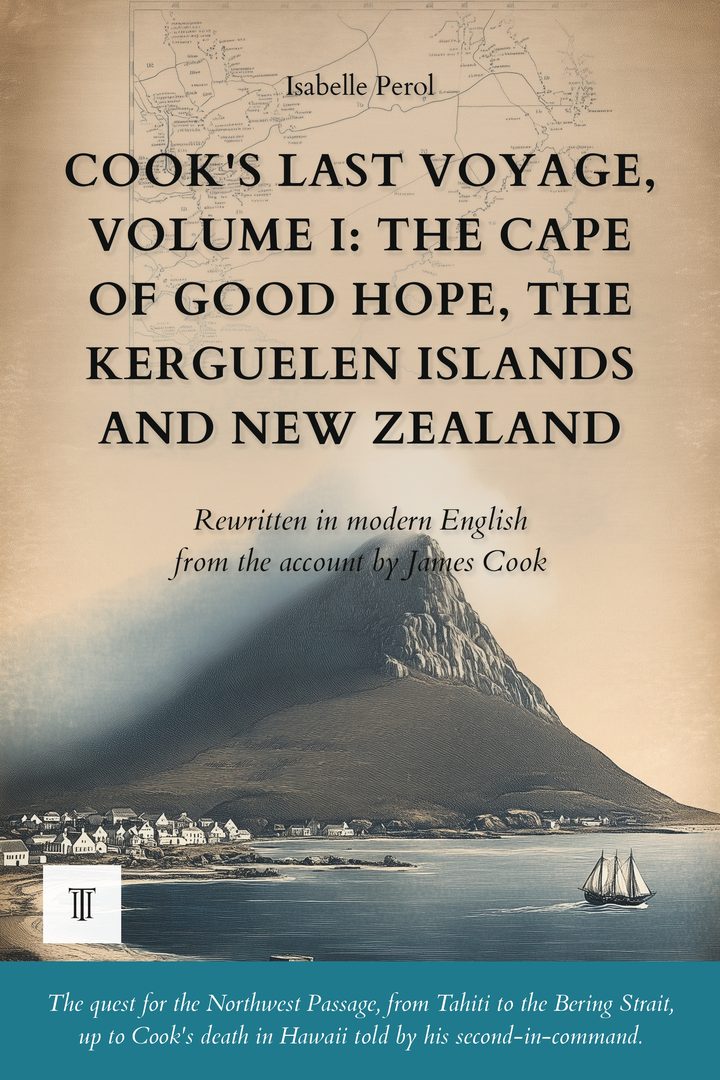
John Ledyard, A Journal of Captain Cook's Last Voyage (1776-1780)
An American corporal of marines was at Kealakekua that morning. Once home, Ledyard published in Hartford, in 1783, an account of the voyage that came out more than a year ahead of the official edition and told of Cook's death without going through the Admiralty. The tone is free, at times borrowed from others, and the judgment on the officers' conduct severe. It is the first counterpoint to the text just read: two men, the same beach, the same quarter hour, and two versions whose comparison has occupied historians ever since.
-
Jean-François de La Pérouse, Voyage autour du monde (1785-1788)
Ten years after Cook, La Pérouse crosses the same waters, calls at the neighbouring Navigator Islands, and loses his second-in-command there in an ambush that answers, like a sinister echo, all the lavish friendships of this volume. His account, saved from the final wreck by copies sent home in time, shows the other side of the Polynesian coin: the same sea, the same magnificent chiefs, and the violence that Cook brushed against without always seeing it coming.
-
Martin Sauer, An Account of a Geographical and Astronomical Expedition to the Northern Parts of Russia (1785-1794)
Secretary of Joseph Billings's expedition, commissioned by Catherine II to survey the coasts between Asia and America, the Englishman Martin Sauer spends nearly ten years in eastern Siberia. He winters in Kamchatka, sails from Petropavlovsk in 1790 and visits the Aleutian Islands, Unalaska and Kodiak. His account, published in London in 1802, dwells on the Aleuts, their kayaks, their parkas, their villages, and plainly denounces the brutality of the Russian fur hunters toward them. Half a century after the meeting at the Shumagin Islands told by Steller, Sauer describes the price these islanders paid for the sea otter that Bering's expedition had made known.
Read a free edition → -
John Meares, Voyages Made in the Years 1788 and 1789, from China to the North West Coast of America (1788-1789)
Cook had scarcely left Nootka before the price of sea otter skins in Canton was already setting merchants in motion. In 1788, Meares settles in the very same bay, builds a small ship there, trades with the chief Maquinna, and his disputed settlement sets off the Nootka crisis that comes close to throwing England and Spain into war. His account, less scrupulous than Cook's, shows the reverse side of discovery: within ten years, the otter cove has become a trading post, and the captain's iron bartering, the first act of a great commerce.
-
John Meares, Voyages Made in the Years 1788 and 1789, from China to the North West Coast of America (1788-1789)
Here is the project of Chapter 19, carried out eight years later by a former naval officer turned merchant. Meares fitted out at Macao, sailed up to Nootka, built a house and a ship there, bought sea otter pelts on the same terms King had calculated, sailed back down to sell them at Canton, and triggered along the way the diplomatic crisis that nearly brought England and Spain to war. His book is boastful and often dishonest, which does not stop it from being the first document of the maritime fur trade, the very trade this volume invented without knowing it.
-
William Bligh, A Voyage to the South Sea (1788-1789)
The Master of the Resolution, the man who sounds the bays of Kerguelen's Land in this volume, returns to Adventure Bay twelve years later aboard the Bounty, plants apple trees on the very same spot, then sets a course for Otaheite, where the mutiny awaits him. To read his account of Van Diemen's Land alongside Cook's is to measure what a pupil retains from a master: the same method, the same gestures, and a temperament that will make all the difference.
-
James Morrison, The Journal of James Morrison, Boatswain's Mate of the Bounty, and Memorandum on Tahiti (1789-1792)
The boatswain's mate of the Bounty, left at Tahiti after the mutiny of 1789, lives there nearly two years before being captured, sentenced, then pardoned. His memoir, written in prison, is the most detailed description we have of Tahitian society before its conversion: the arioi, the morai, the royal maro, the district wars, everything Cook only glimpsed as a visitor. It lights up from the inside the chapters Anderson wrote, twelve years earlier, on the same islands.
-
George Vancouver, A Voyage of Discovery to the North Pacific Ocean (1791-1795)
Vancouver was a midshipman on the Discovery during this voyage. Fifteen years later he commands his own expedition, calls at Dusky Bay and then at Queen Charlotte's Sound, and finds the stumps of the trees felled by Cook's carpenters. The reader sees what becomes, within a generation, of a familiar anchorage and the people who once camped there.
-
Giuseppe Acerbi, Voyage au cap Nord (1802)
At the turn of the nineteenth century, an Italian travels up Scandinavia to the extreme tip of the continent, where Scheffer placed the limits of the known world. Acerbi notes the songs, dances, instruments and daily life of the Sámi with the curiosity of an enlightened amateur. Here we find, alive and changed, the customs that the Lapponia had fixed a century and a half earlier.
-
François Péron, Voyage de découvertes aux terres australes (1800-1804)
The Baudin expedition spends the summer of 1802 in Van Diemen's Land and spends long hours with the inhabitants of the south-east coast, the very people who come out of the woods at Adventure Bay in this volume. Péron, a young scholar as curious as he is talkative, notes their names, their songs, their manners, and takes it upon himself to measure their physical strength, in tests that say more about him than about them. It is the last great testimony before everything changes.
-
Adam Johann von Krusenstern, Voyage Round the World in the Years 1803, 1804, 1805 & 1806 (1803-1806)
Twenty-five years later, Russia finally did what King had imagined for it. Krusenstern linked Kamchatka to Japan and Canton, carried an embassy to Nagasaki that waited six months only to be turned away, surveyed the Kuril Islands and Sakhalin, and sold the Russian-American Company's furs at Canton. Page after page, one reads the programme of Chapter 19 carried out by others, and the first serious answer to the question King left open: what would happen if Kamchatka traded directly with Japan?
-
Georg Heinrich von Langsdorff, Bemerkungen auf einer Reise um die Welt in den Jahren 1803 bis 1807 (1803-1807)
A German physician and naturalist, Georg Heinrich von Langsdorff sails on Krusenstern's Nadezhda for the first Russian circumnavigation. In 1804 he stays in Kamchatka; in 1805 he follows the chamberlain Rezanov to the trading posts of the Russian-American Company, at Unalaska, at Kodiak, then at Sitka where famine rages, before pushing on to California. Returning across Siberia, he publishes his Bemerkungen in 1812. Langsdorff is a direct heir of Steller: the same trade of physician and naturalist, the same curiosity for plants, sea animals and island peoples, and the same critical eye on the otter hunters, sixty years after the shipwreck on Bering Island.
Read a free edition → -
Georg Heinrich von Langsdorff, Bemerkungen auf einer Reise um die Welt (1803-1807)
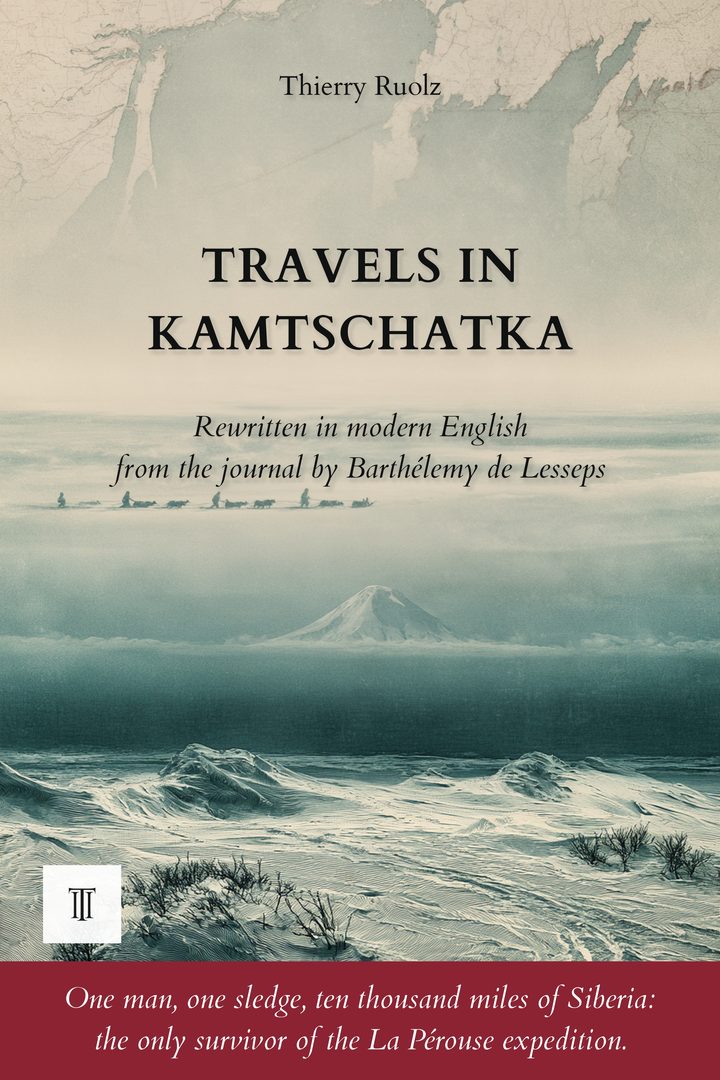
A German physician and naturalist, Langsdorff sailed aboard Krusenstern's Nadezhda on the first Russian circumnavigation. He landed at Petropavlovsk in 1805, in the port where Lesseps had bidden farewell to the Astrolabe eighteen years earlier, then set out for Russian America and California. Back in Kamchatka, he returned to Europe overland, following Lesseps's itinerary almost exactly: Okhotsk, Yakutsk, Irkutsk, Tobolsk, as far as Moscow in the spring of 1808. His Remarks, published in Frankfurt in 1812, combine the eye of the scholar with that of the traveller, and show a Kamchatka still very close to that of the Kamchadals and their dogs.
-
John Martin, Récit de William Mariner aux îles Tonga (1806-1810)
In 1806, an English ship's boy named William Mariner survives the massacre of his ship's crew and lives for four years among the Tongans, adopted by a chief, learning the language and the wars of the archipelago. Dictated to Dr Martin, his testimony is the most intimate account we have of that society from within. It illuminates, better than any other, what Cook could only glimpse from the outside: the meaning of the taboo, the place of the sacred king, the logic of the festivities that this volume describes with wonder.
-
Archibald Campbell, A Voyage Round the World (1809-1810)
Thirty years after the tragedy, a shipwrecked Scottish sailor, both feet amputated, washes up at Hawaii and spends thirteen months there, from 1809 to 1810, under the protection of King Kamehameha, the Maiha-Maiha of this volume. He lives in Honolulu, weaves sailcloth for the sovereign, and observes a court where iron, ships and muskets have changed everything, yet where the old order of the chiefs still holds. No other book shows so well what became, in a single generation, of the world described in the last chapters of this volume.
-
Peter Dobell, Travels in Kamtchatka and Siberia (1812)
Born in Ireland and later in Russian service, Peter Dobell lived for a long time in China and stayed in Kamchatka. In 1812 he undertook the crossing of Siberia as far as Tomsk, by the same posts, the same rivers and the same horse relays as Lesseps. Published in two volumes in 1830, his account mixes practical observations on trade, furs and transport with a long portrait of China, which he knew from the inside. A generation later, we find again the Russian administration, the Yakuts and the long road to Irkutsk, seen through the eyes of a merchant rather than a diplomat.
-
Adelbert von Chamisso, Reise um die Welt mit der Romanzoffischen Entdeckungs-Expedition (1815-1818)
A poet already known for Peter Schlemihl, the man who sold his shadow, Adelbert von Chamisso sails as naturalist on Otto von Kotzebue's Rurik, fitted out by Count Rumyantsev to seek a passage north of America. In 1816 and 1817 the brig calls at Petropavlovsk, cruises in the Bering Strait and puts in at Unalaska, whose Aleuts Chamisso observes with a sympathy rare among the travelers of his time. His account, published in 1836, mixes a voyage journal with learned remarks. Chamisso sails in Bering's wake, and his naturalist's gaze, attentive to plants as much as to people, extends Steller's on the same shores.
Read a free edition → -
Otto von Kotzebue, Entdeckungsreise in die Süd-See und nach der Berings-Straße (1815-1818)
In 1815, a Russian officer sets out again to find, in the very strait where Cook had stopped, the passage he had not been able to force. Aboard the brig Rurik, with the poet and naturalist Chamisso on board, Kotzebue discovers north of the strait a vast bay that today bears his name, and uncovers cliffs of fossil ice mixed with earth. He prowls along the pack ice, questions the Chukchi, and meets the same refusal as his predecessor. Forty years on, the Arctic has given up nothing.
-
Otto von Kotzebue, A Voyage of Discovery into the South Sea and Beering's Straits (1815-1818)
In 1816, a Russian captain set out again to find the passage where Cook and Clerke had failed. He discovered the great sound that now bears his name on the American coast, found cliffs of fossil ice full of mammoth bones, measured the currents of the strait and ran into the same pack ice, in the same place, at the same season. The naturalist aboard, Chamisso, the very man who had written Peter Schlemihl, kept for his part the liveliest journal of the expedition. Two generations, one single barrier.
-
Jacques Arago, A Narrative of a Voyage Round the World (1819)
Draughtsman of the Freycinet expedition, Arago lands at Hawaii in August 1819, a few weeks after the death of Kamehameha and a few months before his son publicly overturns the law of the taboo. He thus witnesses the last summer of the order whose rules King had, forty years earlier, patiently taken apart. His pen is lively, talkative, often unfair, and prodigiously alive; one sees chiefs in European dress, abandoned morais, and prohibitions no one troubles to observe any longer. The end of a world seen by a man who does not know he is watching it.
-
John Dundas Cochrane, Narrative of a Pedestrian Journey through Russia and Siberian Tartary (1820-1823)
A half-pay captain in the Royal Navy, Cochrane decided in 1820 to walk around the world. He crossed Russia and Siberia, pushed on to the Kolyma and the Arctic Sea, then reached Okhotsk and Kamchatka, where he gave up the idea of crossing to America. There he married a young woman born in Bolsheretsk and brought her back to England. His account, published in 1824 and often reprinted, follows much of Lesseps's route in reverse, with a humour and endurance that make it one of the most singular narratives of eastern Siberia. The ostrogs, the sledges and the storms have hardly changed.
Read a free edition → -
Ferdinand von Wrangel, Narrative of an Expedition to the Polar Sea (1820-1824)
Chapter 7 of this volume argues that the coast between Cape Shelagskoy and North Cape must curve westward, and that almost nothing remains unknown. Wrangel went to find out. From 1820 to 1824, he set out from the Kolyma, Deshnev's own river, and pushed out onto the sea ice by dog sledge four times, searching for the land the Chukchi said they could see to the north. He never found it, came close more than once to being lost on a drifting ice floe, but finally surveyed the coast King had guessed at. The island he never reached now bears his name.
-
William Ellis, Polynesian Researches (1822-1825)
A missionary at Huahine and then in Hawaii in the 1820s, Ellis saw both archipelagos of this volume at the hinge of their upheaval. He speaks the languages, gathers genealogies and myths, describes the temples before their demolition and the rites at the moment they are abandoned. His testimony confirms, corrects, and completes almost everything Cook noted in haste, and lets us understand afterward what the sacrifice of Attahooroo meant.
-
John Williams, Récit d'entreprises missionnaires dans les mers du Sud (1823)
The missionary who lands at Rarotonga in 1823 and travels through the Cook Islands and the Friendly Islands opens the century that will transform these societies from top to bottom. His book, a bestseller in Victorian England, tells with fervour what Cook had left untouched and what the mission sets out to remake. Between the two accounts lies everything that shifts: the gods abandoned, the bark cloth replaced, the taboo abolished. Williams pays with his life, at Erromango, for the work he believes he is bringing.
-
Frederick William Beechey, Narrative of a Voyage to the Pacific and Beering's Strait (1825-1828)
In 1826, the Blossom pushes farther than Cook had been able to go. Beechey rounds Icy Cape, reaches Point Barrow, the northwesternmost point of America, and waits there for a Franklin coming overland who never arrives. He completes, mile by mile, the chart this volume left unfinished at the wall of pack ice, and describes the Esquimaux of the coast and their dealings with the Chukchi across the water. His account closes, half a century later, the line Cook had traced to the exact point where the ice had turned him back.
-
Egor Timkovski, Voyage à Péking, à travers la Mongolie, en 1820 et 1821 (1827)
Exactly a century after Unverzagt, Egor Timkovsky, an official of the Russian Asiatic Department, escorts the new Orthodox ecclesiastical mission to Peking, just as Izmailov's embassy had already led an archimandrite there. Setting out from Kiakhta in 1820, he follows the caravan road through Urga, the Gobi and Kalgan, then spends the winter in the Qing capital. His account, translated into French in 1827, abounds in observations on the Mongols, the lamas, the steppe relay stations and the city of Peking. One can measure what has changed in a hundred years, a fixed frontier and trade regulated at Kiakhta, and what endures: the same ceremonial and the same mistrust.
Read a free edition → -
Jules Dumont d'Urville, Voyage au pôle Sud et dans l'Océanie (1827-1840)
The French navigator crosses New Zealand twice, in 1827 and again in 1840, and anchors in Queen Charlotte's Sound on the eve of the Treaty of Waitangi. He knows his Cook by heart and quotes him at every cove. Sixty years lie between the two accounts: the muskets, the missions, the wars that empty the bays, and chiefs who now know very well what a ship's arrival means.
Our edition → -
Charles Wilkes, Narrative of the United States Exploring Expedition (1840)
What Cook's expedition had missed, America accomplished in 1840. Wilkes led two hundred men and tons of instruments to the summit of Mauna Loa, camped there for weeks in the snow, and measured gravity with a pendulum. The account of that ascent, with its Hawaiian porters, its frozen tents and its smoking crater, answers directly to the aborted climb of chapter 8, when three officers turned back before a field of scorched stone. Sixty years separate the two attempts, and the same volcano measures them both.
-
Xavier Marmier, Lettres sur le Nord (1840)
A romantic and learned traveller, Marmier journeyed through Scandinavia around 1840 and brought back from Lapland pages where emotion competes with observation. He visits the parishes, listens to the pastors, collects traditions and wonders about the future of a people that modernity is beginning to press closely. The book extends, in French, Scheffer's gesture: making the North known to those of the South.
-
Évariste Huc, Souvenirs d'un voyage dans la Tartarie, le Thibet et la Chine (1850)
In 1844, the Lazarist priests Évariste Huc and Joseph Gabet leave their mission at Xiwanzi, north of the Great Wall, not far from Kalgan where Unverzagt entered China. Dressed as lamas, they cross the Mongolian steppes with their camels, sharing the yurts, the tea and the festivals of the nomads, then press on to Lhasa, from which they are expelled. Their account, full of humour and lived detail, was one of the great bestsellers of the century. It brings to life what Unverzagt notes in passing: the camps, the lamas, the caravans and the immensity of the steppe between China and the Russian world.
Read a free edition → -
George Kennan, Tent Life in Siberia (1865-1867)
At twenty, the American George Kennan joined the team charged with surveying the route of a telegraph line that was to link America to Europe across the Bering Strait and Siberia. He landed in Kamchatka, went up the peninsula, then spent two winters in Koryak country around Gizhiga, Lesseps's Ingiga. Reindeer-skin tents, dog sledges, storms, nomads by turns wary or hospitable: nearly eighty years later, he crosses the same white deserts. Published in 1870, his lively and often funny book is the best companion to Lesseps's Koryak chapters, down to the abandonment of the project when the transatlantic cable made it pointless.
Read a free edition → -
George Kennan, Tent Life in Siberia (1865-1867)
In 1865, an American company set out to link New York to Moscow by telegraph, routed through Alaska, the Bering Strait and Siberia. Kennan, twenty years old, was tasked with surveying the line from Kamchatka to the Anadyr. He lived for two years among the nomadic Koryaks and the Chukchi, described their reindeer herds, their jourts and their shamans, and found himself one day a thousand versts from anywhere, learning that the transatlantic cable had just been laid and that his telegraph line no longer had any purpose. The country of Chapters 11 to 14, a century later, almost unchanged.
-
Mark Twain, Letters from the Sandwich Islands (1866)
In 1866 a young journalist lands at Honolulu for a Sacramento newspaper and stays four months. Twain visits the plantations, descends into the crater of Kilauea, tries surfing and drinks the cup, then has himself taken to Kealakekua, before the monument to Cook, where he writes a few cold pages on what the captain did or did not deserve. The comedy poorly covers a real melancholy: the kingdom he crosses is that of this volume, but depopulated, converted, indebted, and already turning toward California.
-
Vasily Vereshchagin, Tableaux et croquis de l'Asie centrale (1870)
The great Russian painter, who follows Konstantin von Kaufman's military expedition to Turkestan in the 1860s and 1870s, paints Samarkand, Khiva, and Bukhara before they are absorbed into Russia. His descriptions accompanying the paintings depict a Central Asia still recognizable from Schiltberger's: local emirs, religious fanaticism, Circassian slaves, processions of horsemen. The last years when the steppe still looked like the steppe.
-
Isabella Bird, Six Months in the Sandwich Islands (1873)
In 1873, a forty-year-old Englishwoman, sickly and fearless, travels across Hawaii on horseback, sidesaddle then astride, sleeps in huts, descends to the rim of the Kilauea crater, and rides up the valleys of Kauai. A century after Cook, she finds a Christian kingdom, a constitutional monarchy, sugar plantations, and beneath all of it the same volcanic land and the same names. The contrast with the beach at Waimea in January 1778 fits into a single book.
-
Nikolaï Prjevalski, Mongolia i strana tangutov (1875-1876)
In 1870, the Russian officer Nikolai Przhevalsky sets out from Kiakhta, close to the Selenginsk where Unverzagt awaited Chinese permission, and crosses the Gobi by way of Urga and Kalgan to Peking. It is the start of a three-year expedition that carries him on into the Ordos, the Alashan, the Koko Nor and the borders of Tibet. A naturalist as much as a soldier, he describes the steppe, the wells, the sandstorms, the birds and the plants with new precision. His book, translated into English as early as 1876, moves the road of the embassies from court narrative to exploration: the same steppe, now regarded for its terrain and wildlife rather than its ceremonial.
Read a free edition → -
Robert Louis Stevenson, In the South Seas (1888-1890)
Ill and seeking a climate, the Scottish writer sails from 1888 to 1890 from the Marquesas to the Gilberts, listens, questions, and refuses the postcard view. He describes societies that still remember the tabou and the morai, and a depopulation he attributes plainly to European contact. On the Society Islands, and on what Cook left there without meaning to, his pages are worth more than many treatises.
-
Lord Curzon, Russia in Central Asia (1889)
The future Viceroy of India publishes in 1889 his account of a journey through the newly conquered Russian Turkestan. Schiltberger had seen Sarai on the Volga in its splendor; Curzon crosses its ruins of sand. A thousand roads the Bavarian had traveled as a captive, the Englishman retraces by trans-Caspian railway. Industrial modernity has replaced the nomadic steppe.
-
Anton Tchekhov, L'Île de Sakhaline (1890)
In the spring of 1890, Chekhov, already famous, set out alone for the penal island of Sakhalin. Before reaching it, he crossed Siberia by tarantass on the great road that Lesseps had taken in the opposite direction: Tomsk, Krasnoyarsk, Irkutsk, with mud, ferries, relay stations and convoys of deportees. On the island, he himself counted thousands of convicts and settlers, card after card. The book, which appeared in 1893 and 1895, is a relentless inquiry into the Siberian exile that Lesseps had only glimpsed: the exiles who haul his boat on the Lena and run away, the galley convicts met on the road to Nerchinsk, here become the very subject of the journey.
-
Basil Thomson, Les Distractions d'un premier ministre (1890-1891)
At the end of the nineteenth century, a young British official becomes, almost by chance, prime minister of the kingdom of Tonga, the only Polynesian state never to have been colonised. His book, witty and perceptive, describes a monarchy heir to the old order of Poulaho's Tu'i Tonga, with its rites, its ranks and its taboos still very much alive. Beneath the Christian veneer, one recognises the archipelago that Cook had believed he understood, and the sacred kingship he had sensed behind the pomp of Feenou.
-
Paul-Émile Victor, Boréal
Much later, a Frenchman goes to live among the peoples of the Arctic and returns with an account of immersion. Though the region differs, his gaze converses with Scheffer's: the same world of snow, reindeer and tents, but now told from within, by someone who shared the cold instead of compiling it. Read it to measure the distance travelled between learned description and lived experience.
-
Raymond Rallier du Baty, Aventures aux Kerguelen (1907-1909)
In 1907, a young Breton buys an old dundee, names her the J.-B. Charcot, and sets off with five men to spend more than a year on the land Cook called the Island of Desolation. He hunts sea-elephants, draws charts, winters in the fjords, and describes the same blue rock, the same kelp, the same penguins by the thousand. No other book better conveys what Cook only skirted for eight days.
-
Luigi Barzini, La metà del mondo vista da un'automobile. Da Pechino a Parigi in 60 giorni (1908)
On 10 June 1907, Prince Scipione Borghese launches his Itala in the Peking-to-Paris race, and the journalist Luigi Barzini keeps the crew's chronicle. The car leaves China by way of Kalgan, crosses the Gobi, passes through Urga and Kiakhta, skirts Lake Baikal, goes through Irkutsk, Tomsk and the Urals, then reaches Moscow and Saint Petersburg: Unverzagt's itinerary, or nearly, in reverse and in two months. Barzini tells of broken tracks, collapsing bridges, Siberian villages and crowds rushing out to see. Two centuries later the same road is still an ordeal, but it is now run for speed rather than for a treaty.
Read a free edition →