 Region and period
Travel narratives of Asia in the 17th century
In the seventeenth century, the story of Asia turns on one great upheaval: the fall of the Ming. In 1644 Beijing fell to rebels and then to the Manchus, who founded the Qing dynasty and spent nearly forty years bringing the south and Taiwan under control. For the first time, Europeans watched a change of Chinese dynasty from the inside. The Jesuit Martino Martini, back in Rome, published an account of it as early as 1654, On the Tartar War, read all over Europe, followed in 1655 by an atlas of China province by province.
Overland travel revived. The lay brother Bento de Góis left Lahore in 1602 and died in 1607 at the gates of China, having shown that the Cathay of the Silk Road merchants and the China of the seafarers were one and the same. In 1624 António de Andrade crossed the Himalaya to Tsaparang in western Tibet; in 1661 Johann Grueber and Albert d'Orville travelled from Beijing to Agra by way of Lhasa. The Russians, who reached the Pacific in 1639, sent embassies to Beijing, Fyodor Baykov's in 1654-1656 and Nicolae Milescu's in 1675-1678, and the Treaty of Nerchinsk in 1689 was negotiated in Latin, with two Jesuits as interpreters.
The trading companies, for their part, sought access to the emperor. The Dutch embassy received in Beijing in 1656 achieved almost nothing, but its steward Johan Nieuhof turned it into a book with dozens of engravings that fixed Europe's picture of Chinese cities, pagodas and junks for a century. At court, Adam Schall and then Ferdinand Verbiest ran the Astronomical Bureau; in 1668-1669 Verbiest won a public forecasting contest against the Chinese astronomers before the assembled ministers.
Asia travelled too, towards Europe and towards its neighbours. The samurai Hasekura Tsunenaga crossed the Pacific and the Atlantic and was received by the Pope in 1615. Until the 1630s, ships carrying the shogun's red seal traded across Southeast Asia, and Japanese quarters grew up in Manila and Ayutthaya. Siam, having welcomed the Chevalier de Chaumont's embassy in 1685, sent its own to Versailles in 1686; Simon de La Loubère, the next French envoy, published in 1691 a strikingly sober description of the kingdom.
This collection brings together our editions and a directory of related texts.
Our titles on this subject

Further reading: accounts and works on the same theme
Accounts and works around this subject, in date order, to place our titles in context. Each links to a free online edition when one exists, or to our own page when the work is in our catalogue.
-
Hendrik Hamel, Journal of the Wreck of the Dutch Ship Sparwehr on the Coast of the Island of Quelpaert (1653-1666)
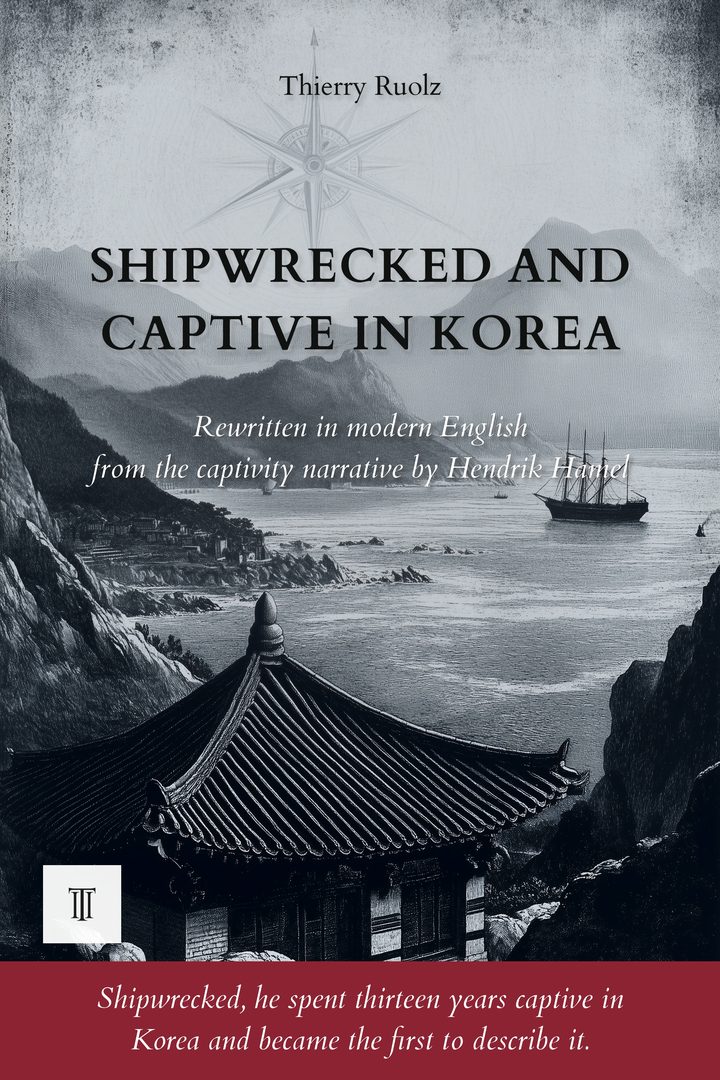
While Jacques de Bourges is crossing the Syrian desert, a Dutch bookkeeper is in his eighth year of captivity in Korea. Shipwrecked in 1653 on the island of Jeju with thirty-six companions, Hamel has been held by a kingdom that never lets a foreigner leave. He escapes in 1666, the very year the Account of the Voyage of Berytus appears, and publishes the first Western portrait of Korea. Two men, two Asian impasses: one cannot get in, the other cannot get out. The same sober style, the same attention to prices, to clothing, to the rules of politeness.
-
Johan Nieuhof, An Embassy from the East-India Company of the United Provinces to the Grand Tartar Cham, Emperor of China (1655-1656)
Here is the empire Lambert de la Motte will never reach, seen from within and in exactly those same years. Nieuhof accompanies the Dutch embassy that travels from Canton to Peking in 1655 and 1656, under the new Manchu masters. His book, published in 1665, offers hundreds of engravings and fixes for a century the European image of China. To read it against the Account is to measure the gap between missionary ambition and political reality: Canton, three weeks by sea from Ayutthaya, was already a port under close watch.
-
Athanasius Kircher, China Illustrata (1667)
The German Jesuit Kircher published in 1667, at the very moment Hamel was waiting at Deshima, an illustrated compendium on China, based on missionary reports. His Korea was still largely imaginary. The publication of these two works in successive years is telling: learned Europe had its China; now it discovered its Korea.
-
Ferdinand Verbiest, Voyages de l'empereur de la Chine dans la Tartarie (1685)
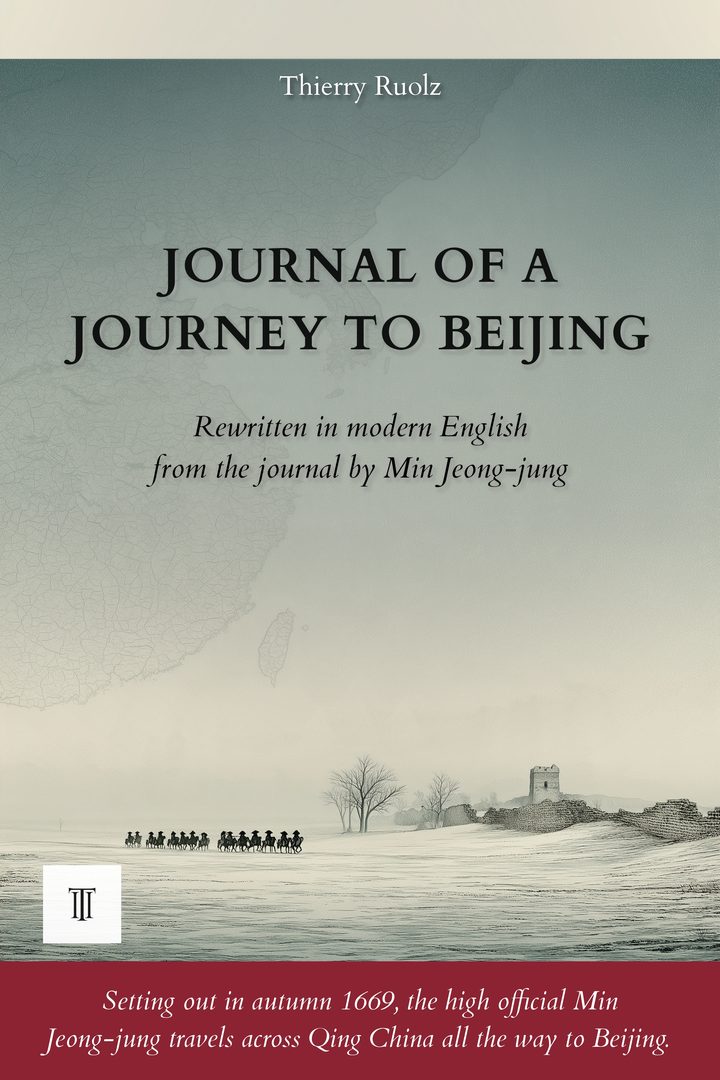
Thirteen years after Min Jeong-jung, the Flemish Jesuit Ferdinand Verbiest, astronomer at court, accompanied the Kangxi emperor on his great tour of Manchuria in 1682: Shenyang, the tombs of the Manchu ancestors, then the northern forests as far as Ula. His letter, published in French in 1685, describes the immense retinue, the imperial hunts and the lands emptied by the conquest. The fifteen-year-old whom Min had glimpsed in Beijing has become a self-assured sovereign returning on pilgrimage to the land of his fathers. The two texts complete each other: Manchuria seen by an anxious tributary, then by the emperor's guest.
Read a free edition →