Our titles on this subject
17th century

Further reading: accounts and works on the same theme
Accounts and works around this subject, in date order, to place our titles in context. Each links to a free online edition when one exists, or to our own page when the work is in our catalogue.
-
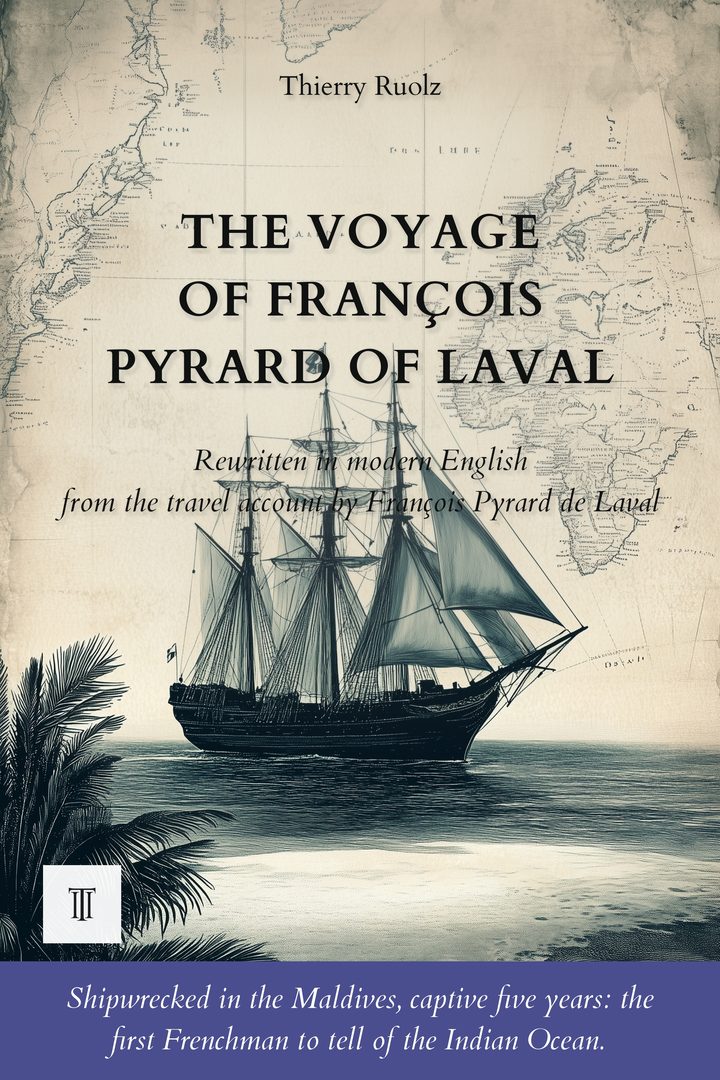
Pieter van den Broecke, Journal des voyages aux Indes orientales (1605-1630)
A merchant in the service of the young Dutch Company and an exact contemporary of Pyrard, van den Broecke traded at the same time in the gulf and along the same coasts where Pyrard wandered as a prisoner. His dry merchant's journal, attentive to cargoes and the price of pepper, sheds light by contrast on what Pyrard leaves unsaid: the fierce commercial war that Portuguese, Dutch and English waged on these waters while a castaway was learning their languages and customs.
-
John Smith, A True Relation of such Occurrences and Accidents of Noate as hath hapned in Virginia (1608)
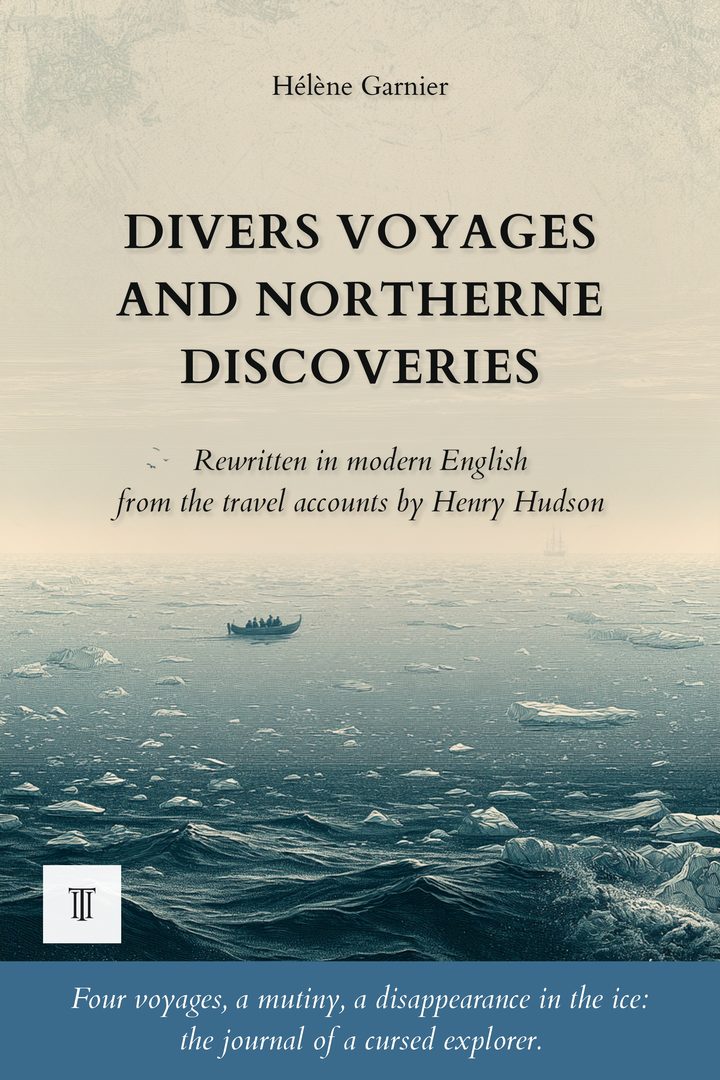
On 1 May 1607, Hudson left Gravesend for the Pole; two weeks later, on the other side of the Atlantic, about a hundred English colonists landed on the James and founded Jamestown. John Smith, a soldier of fortune, faced hunger, fevers, the quarrels of the leaders, then captivity among Powhatan's men. His True Relation was printed in London as early as 1608. Smith did more: he sent Hudson letters and maps holding out the hope of an open sea north of Virginia. It was on that belief, Van Meteren reports, that Hudson turned west in 1609, and in August Juet notes the entrance of the King's River, “where our Englishmen are”.
Read a free edition → -
William Hawkins, Relation de son séjour à la cour du Grand Moghol (1608-1613)
An English captain who landed at Surat in 1608, the very year Pyrard was thrown into prison at Cochin, Hawkins travelled up to Agra and the court of Emperor Jahangir. While the Frenchman discovers India from below, as a captive on the coasts, the Englishman discovers it from above, among the elephants and jewels of the Mughal palace. Two Europeans, two opposite fortunes, the same subcontinent seized at the same date.
-
Pedro Teixeira, Relations du voyage d'Ormuz et de Perse (1610)
A Portuguese traveller who crossed Hormuz, Persia and the Indian Ocean in the first decade of the century, Teixeira describes that bolt on Eastern trade which Pyrard glimpses only from afar, in his chapter on the Deccan. His account gives flesh to those names of distant ports which, for the man from Laval, are only stopovers heard of from others.
-
William Adams, Lettres du Japon (dans Memorials of the Empire of Japon) (1611)
An English pilot in a Dutch fleet that had sailed from Rotterdam in 1598, William Adams reached Japan in April 1600 aboard the Liefde, the only ship of the expedition to make the archipelago, with a crew at the end of its strength. He won the trust of Tokugawa Ieyasu, built European-style ships for him, and received an estate and a Japanese name, Miura Anjin. In 1611, he wrote to his “unknown friends and countrymen” a letter recounting this odyssey; Purchas would print it in 1625, in the same collection as Hudson's journals. The Japan that Hudson stubbornly sought through the polar ice, Adams was already living in, having arrived from the south. The two routes answer each other, one through success, the other through failure.
Read a free edition → -
Samuel de Champlain, The Voyages of Samuel de Champlain (1613)
On 3 July 1608, while Hudson was returning from Novaya Zemlya, Samuel de Champlain founded Quebec on the banks of the St. Lawrence. The following winter, scurvy decimated the little colony. In the spring, Champlain allied himself with the Montagnais, the Algonquins and the Hurons, went up the River of the Iroquois and discovered the lake that would bear his name. On 30 July 1609, the shots of his arquebus broke the charge of a band of Mohawks there. Two months later, Hudson sailed up from the south the river to which this same waterway leads. The two men never met, but his Voyages, published in Paris in 1613, tell the other half of that summer when two Europeans, a few weeks apart, entered the country of the future State of New York.
Read a free edition → -
Pietro Della Valle, Viaggi (1614-1626)
A Roman gentleman, Pietro Della Valle leaves Venice in 1614 for Constantinople, Egypt and Jerusalem, then reaches Baghdad, where he marries Maani, a young Christian woman of the city. From 1617 to 1621 he lives in Persia and meets Shah Abbas I, of whom he leaves a famous portrait. Maani dies of fever in 1621; he has her body embalmed and carries it to Rome. His long letters, published from 1650, form one of the great travel narratives of the century. The same era as Munk, the opposite tone: the talkative curiosity of a man of letters beside the laconic journal of a sailor.
-
George Sandys, A Relation of a Journey begun An. Dom. 1610 (1615)
In 1610, the year Hudson entered the strait that now bears his name, the young George Sandys set out for the East. By way of Venice he reached Constantinople, then Egypt and Cairo, the Holy Land and Jerusalem, before returning by Cyprus, Sicily and Rome. His Relation, published in London in 1615, describes the Ottoman Empire with a humanist's eye: monuments, customs, religions, and the memory of the Ancients. The contrast with the ice of the bay could not be greater: a route travelled for centuries, cities laden with memory. Yet one thread links the two travellers: Virginia, whose coast Hudson followed in August 1609, and where Sandys would go in 1621 as treasurer of the colony.
Read a free edition → -
Sir Thomas Roe, The Embassy of Sir Thomas Roe to the Court of the Great Mogul (1615-1619)
From 1615 to 1619, the ambassador of James I and of the English East India Company follows the court of the Mughal emperor Jahangir. His journal and letters tell of audiences, gifts judged too modest, rivalries with the Portuguese and the slow winning of protection for the trading post at Surat. Roe leaves India the very year Munk sets sail: the two men serve northern crowns that seek, each in its own way, the spice route, one by diplomacy in the richest empire of Asia, the other through the ice of a sea still unnamed on Danish maps.
Read a free edition → -
Thomas Roe, The Embassy of Sir Thomas Roe to the Court of the Great Mogul, 1615-1619 (1615-1619)
Landing at Surat in September 1615, the ambassador of James I follows the court of the emperor Jahangir to Ajmer and then to Mandu, to wrest trading privileges for the English East India Company. His journal and letters, published in 1899 by the Hakluyt Society, describe the audiences, the gifts judged too meagre, the rivalry with the Portuguese and the splendour of an empire far greater than the kingdoms of Europe. At the same moment Bénard is bargaining with the Attala of Ramla and the Turkish customs men: two Europeans entering, each on his own scale, the game of tributes and passports of a great Muslim empire.
Read a free edition → -
Richard Cocks, Diary of Richard Cocks, Cape-Merchant in the English Factory in Japan, 1615-1622 (1615-1622)
Head of the English trading post at Hirado, Richard Cocks keeps his diary from June 1615. In it he records the cloth that finds no buyers, the gifts to the lords, the advice of the pilot William Adams and, in 1616, the journey to the shogun's court to have privileges confirmed that the death of Tokugawa Ieyasu has called into question. Japan is then slowly closing itself to missionaries. To read Cocks alongside Bénard is to see two Christians of the same time, one a merchant, the other a pilgrim, coming to terms with a suspicious foreign power, and drawing from it pages of day-to-day precision.
Read a free edition → -
Jean Mocquet, Voyages en Afrique, Asie, Indes orientales et occidentales (1616)
Apothecary to King Henry IV, Mocquet travelled the world in the same years as Pyrard and sometimes followed the same routes: the Cape, Goa, Malabar. Where Pyrard observes as a patient captive, Mocquet collects for the royal cabinet, bringing back plants, stuffed animals, and tales of shipwreck and fever. Read side by side, the two Frenchmen of the early years of the century compose a portrait in two voices of this maritime East that France was then discovering late, in fragments carried home in sailors' chests.
-
Willem Schouten, Journael ofte beschrijvinghe van de wonderlijcke reyse (1618)
While the Danes look for a passage by the north, the Dutch find one by the south. Setting out from the Texel in 1615 with the Eendracht and the Hoorn, Willem Schouten and Jacob Le Maire round in 1616 the cape they name Horn, after their second ship, lost in Patagonia. They cross the Pacific by way of the Tuamotus, Tonga and Futuna, skirt New Guinea, then see their ship seized in the Indies by the Company, which accuses them of breaching its monopoly. The journal appears in Amsterdam in 1618: the same fever for straits as Munk's, at the other end of the globe.
-
Willem Schouten et Jacob Le Maire, Journal ou description du merveilleux voyage de Guillaume Schouten (1618)
Sailing from Texel in June 1615 with the Eendracht and the Hoorn, Dutch merchants look for a passage to the Pacific outside the monopoly of the East India Company. The Hoorn burns on the coast of Patagonia; the Eendracht alone passes through the Le Maire Strait and, at the end of January 1616, rounds the cape they name Hoorn. Then come the Pacific islands, from Tonga to New Ireland, and Batavia, where the Company seizes the ship. Le Maire dies on the voyage home, and Schouten returns in July 1617, the very month Bénard leaves Rome. The same sea of storms, at the other end of the world.
Read a free edition → -
Samuel de Champlain, Voyages et descouvertures faites en la Nouvelle France, depuis l'année 1615 jusques à la fin de l'année 1618 (1619)
In the autumn of 1615, while Bénard is still only a young Parisian dreaming of Jerusalem, Champlain paddles up the Ottawa River by canoe, reaches Georgian Bay and spends the winter among the Wendat. He goes with them against a fortified Iroquois village, takes arrows in the knee and has to be carried in a basket on the backs of his allies. He returns to France in 1616, the year Bénard boards the Lyon coach. Two Frenchmen of the same reign, two ways of setting out: one towards a holy land known from Scripture, the other towards Great Lakes still missing from the maps.
Read a free edition → -
Samuel de Champlain, Voyages et descouvertures faites en la Nouvelle France (1619)
In 1615, four years before Munk leaves Copenhagen, Champlain paddles up the Ottawa River by canoe to the country of the Hurons, at the other end of the same continent. He joins an expedition against an Iroquois stronghold south of Lake Ontario, then spends the winter of 1615-1616 in Huronia, where he observes villages, crops and alliances. Published in 1619, the very year of the Danish departure, his account shows another way of entering North America: by rivers and with Indigenous guides, where Munk ventures in by sea, without an interpreter, and finds himself alone before the winter.
Read a free edition → -
Jerónimo Lobo, Itinerário (Voyage historique d'Abissinie) (1622-1640)
A Portuguese Jesuit, Jerónimo Lobo lands in 1625 on the Red Sea coast with the patriarch Afonso Mendes and makes his way to the Ethiopian highlands. He lives there for nearly ten years, visits the sources of the Blue Nile in 1629 and witnesses the end of the mission when the new emperor Fasilides drives out the Catholics. His Itinerário, long left in manuscript, was translated into French by the abbé Le Grand in 1728, then abridged in English by Samuel Johnson. Like Munk, Lobo tells of a world closing in on foreigners, here through politics and religion, there through cold and disease.
Read a free edition → -
Jean-Baptiste Tavernier, The Six Voyages (1631-1668)
The necessary companion to this reading. A dealer in precious stones, Tavernier travels the very road of the Account six times between 1631 and 1668: Aleppo, the desert, Baghdad, Isfahan, Gombroon, Surat, Golconda. He knows every caravanserai, every customs house, every exchange rate, and describes the diamond mine of the King of Golconda that Bourges only glimpsed. Where the priest counts souls, the merchant counts carats. The two books overlap so often that together they form the best guide to the overland route to Asia in the seventeenth century.
-
Thomas James, The Strange and Dangerous Voyage of Captaine Thomas James (1633)
In May 1631, Thomas James left Bristol aboard the Henrietta Maria to take up the quest where Hudson had left it. In the bay he met another seeker of the passage, Luke Foxe, who had sailed from London the same season, then headed south, into the bottom of the bay where Hudson had wintered and which today bears the name of James. He spent the winter on Charlton Island, deliberately sank his ship to save it from the ice, refloated it in the spring and returned to Bristol in October 1632. His Strange and Dangerous Voyage, published in 1633, tells of hunger, cold and prayer, and reaches the same conclusion as Hudson's journals: that way, no passage opens toward Asia.
Read a free edition → -
Adam Olearius, Offt begehrte Beschreibung der newen orientalischen Reise (1633-1639)
A few years before Tasman, the secretary of an embassy of the Duke of Holstein sails down the Volga, crosses the Caspian and reaches Isfahan to open a silk route through Russia. Adam Olearius publishes his account in 1647, while Tasman's journal lies buried in the Company's archives. The project fails, as Tasman's does in commercial terms: neither Persia nor the Southland yields the hoped-for wealth. But Olearius leaves a meticulous description of Muscovy and Safavid Persia, with the same surveyor's precision as the chief pilot Visscher in his charts.
-
Luke Foxe, North-West Fox, or Fox from the North-West Passage (1635)
Twelve years after Munk, in 1631, Luke Foxe leaves London in the Charles, a small pinnace, passes by Orkney and enters Hudson Strait in June. He follows the west coast of the bay, finds at Port Nelson the traces of Thomas Button's wintering, meets his rival Thomas James by chance, then heads north into the basin that now bears his name. He returns in October having neither wintered nor lost a man. His book, published in 1635, mixes ship's journal with a history of earlier voyages: ideal reading for measuring what Munk had paid so dearly.
Read a free edition → -
Evliya Çelebi, Book of Travels (1640-1676)
In 1640, two years before Tasman's departure, a young scholar from Istanbul vows to travel after a dream in which the Prophet urges him to. For nearly forty years Evliya Çelebi journeys through the Ottoman Empire and its neighbours, from the Caucasus to Egypt, from Vienna to Persia, and draws from it the ten volumes of his Book of Travels. Everything sets the two authors apart: the Dutch commander counts miles and fathoms, the Ottoman tells stories, exaggerates, marvels. Yet both write to take stock of a world, one in the service of a company of merchants, the other for the glory of an empire.
-
Hendrick Brouwer et Elias Herckmans, Journael ende historis verhael van de reyse gedaen by oosten de Straet le Maire, naer de custen van Chili (1642-1643)
While Tasman believes that the New Zealand coast is a piece of Le Maire's Staten Landt, a fleet of the West India Company rounds Cape Horn east of that same Staten Landt and proves it is only an island. Hendrick Brouwer, a former governor-general in Batavia, wants to ally with the Mapuche against Spain and gain a foothold at Valdivia. He dies at Chiloé in August 1643; Elias Herckmans occupies Valdivia and then abandons it in the autumn. Published in Amsterdam in 1646, this account undoes Tasman's hypothesis: his Staten Landt will become New Zealand.
-
Isaac Jogues, Novum Belgium (1642-1643)
In August 1642, the very month Tasman leaves Batavia, the Jesuit Isaac Jogues is captured on the St Lawrence by Mohawk warriors. A year of captivity, torture and survival in the Iroquois villages ends in the summer of 1643 thanks to the Dutch of Fort Orange, who help him escape and take him to New Amsterdam. From this passage comes a short Latin description of New Netherland, Novum Belgium, in which Jogues marvels that eighteen languages are spoken around the fort on Manhattan. In the same years, at the other end of the world, the merchant republic is extending its trading posts from the Hudson to Java.
Read a free edition → -
Maarten Gerritsz Vries, Reize van Maarten Gerritsz. Vries in 1643 naar het noorden en oosten van Japan (1643)
The same governor-general, Antonio van Diemen, who sends Tasman south dispatches two ships north in the spring of 1643, the Castricum and the Breskens. Beyond Japan, Maarten Gerritsz Vries looks for lands of gold and silver: he follows the coast of Hokkaido, passes between the Kurils, names one island Staten Eylandt and a coast Compagnies Landt, and reaches southern Sakhalin. The two journals are the two arms of one pair of compasses: Batavia probes the southern unknown and the northern unknown at the same time, with the same instructions, the same ship's councils, and the same habit of scattering the names of the Company's great men across the maps.
Read a free edition → -
Adam d'Olearius, Voyage en Moscovie, Tartarie et Perse (1647)
In the same decades, a German scholar crosses the Russia of the tsars and travels down to Safavid Persia, notebook in hand. Olearius observes, measures, draws, doubts; he brings back an Asia that Europe knows only by hearsay. Read alongside Scheffer, his book shows two neighbouring ways of investigating a distant world: one in the field, the other from his study, yet both driven by the same appetite for verified truth.
-
Adam Olearius, Voyages très curieux faits en Moscovie et en Perse (1647-1656)
Secretary to a Holstein embassy, Olearius travelled through Russia and Persia between 1633 and 1639. His book, published in several editions from 1647 to 1656, is remembered for its ethnographic precision. The comparison with Hamel is instructive: the same European generation was trying to understand Asian kingdoms with the same limited intellectual tools, one in a known land, the other in a land wholly closed.
-
Pietro della Valle, Viaggi di Pietro della Valle il pellegrino (1650-1663)
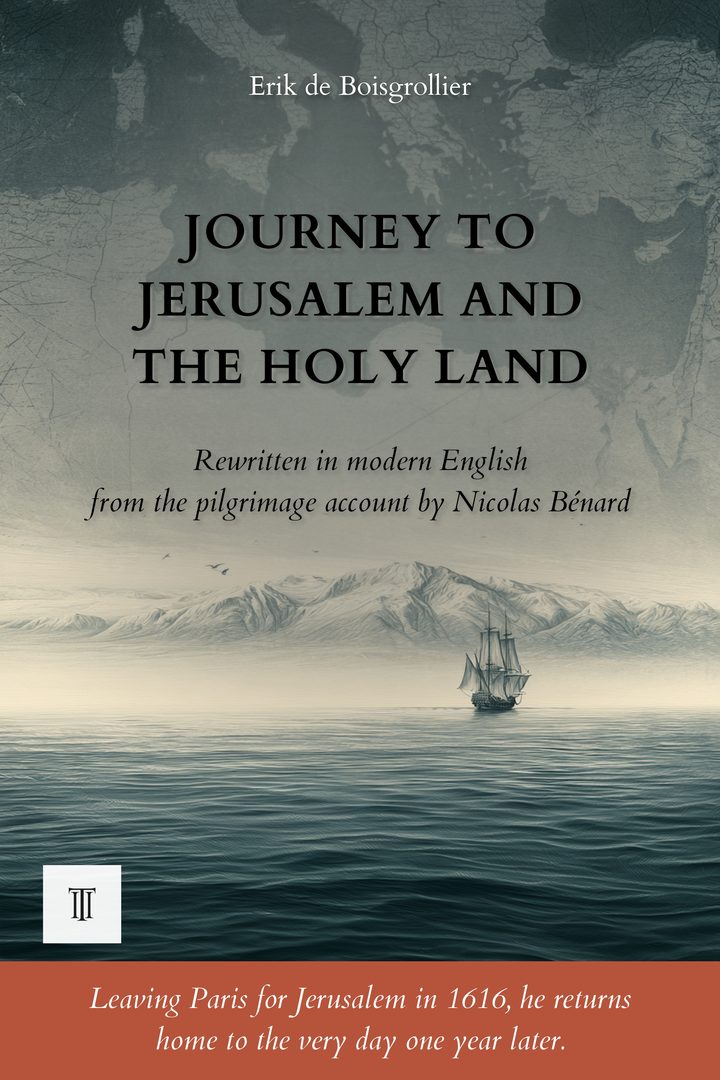
The Roman nobleman reaches Jerusalem on 8 March 1616 for the Easter festivities, ten months before Bénard, and visits the same shrines, lodged like him with the Franciscans. But he does not go home: he travels on to Damascus and Aleppo, marries a Syrian Christian, Sitti Maani, in Baghdad, and leaves for the Persia of Shah Abbas in January 1617, just as Bénard lands at Sidon. His letters, published in Rome from 1650 to 1663, then lead all the way to India. The Parisian pilgrim sees the Holy Land as a journey's end; the Roman pilgrim makes it the gateway to an East he wants to understand.
Read a free edition → -
Hendrik Hamel, Journal of the Wreck of the Dutch Ship Sparwehr on the Coast of the Island of Quelpaert (1653-1666)
While Jacques de Bourges is crossing the Syrian desert, a Dutch bookkeeper is in his eighth year of captivity in Korea. Shipwrecked in 1653 on the island of Jeju with thirty-six companions, Hamel has been held by a kingdom that never lets a foreigner leave. He escapes in 1666, the very year the Account of the Voyage of Berytus appears, and publishes the first Western portrait of Korea. Two men, two Asian impasses: one cannot get in, the other cannot get out. The same sober style, the same attention to prices, to clothing, to the rules of politeness.
-
Johan Nieuhof, An Embassy from the East-India Company of the United Provinces to the Grand Tartar Cham, Emperor of China (1655-1656)
Here is the empire Lambert de la Motte will never reach, seen from within and in exactly those same years. Nieuhof accompanies the Dutch embassy that travels from Canton to Peking in 1655 and 1656, under the new Manchu masters. His book, published in 1665, offers hundreds of engravings and fixes for a century the European image of China. To read it against the Account is to measure the gap between missionary ambition and political reality: Canton, three weeks by sea from Ayutthaya, was already a port under close watch.
-
Antoine Biet, Voyage from Equinoctial France to the Island of Cayenne (1664)
Published in 1664, two years before the Account, the story of a priest who set out to found a French colony on the other side of the world. The same decade, the same thrust of Colbert's France toward distant lands, the same blend of religion and trade, but with a disastrous outcome: the colony of Cayenne collapses in sickness and discord. Biet observes the Galibi with a curiosity that resembles Bourges's toward the Siamese, and comparing the two ventures illuminates what the Asian route owed to patience.
-
Jean de Thévenot, Relation d'un voyage fait au Levant (1664)
Forty years after Bénard, another young Parisian sets out for the Levant, in 1655. Jean de Thévenot spends several years in Constantinople, Egypt and the Holy Land, where he too receives the knighthood of the Holy Sepulchre. But where Bénard counts indulgences, Thévenot observes customs, coins, coffee houses and caravans with the curiosity of a traveller rather than a pilgrim. His account appeared in 1664 and was often reprinted. He then left again for Persia and India and died on the way home, in 1667. The two books show how, within a generation, pilgrimage turns into a journey of observation.
Read a free edition → -
Evliya Çelebi, Seyahatname (Book of Travels) (1665)
In 1665 Evliya Çelebi accompanied the Ottoman embassy of Kara Mehmed Pasha to Vienna, sent to ratify the Peace of Vasvár with Emperor Leopold I. In his Book of Travels he describes the city, St Stephen's Cathedral, the hospitals and the ceremonial of imperial audiences, with the taste for anecdote and exaggeration that gives all his work its charm. Four years later Min Jeong-jung made a mirror-image journey in Beijing. Two envoys convinced of the superiority of their own civilisation observe a court they consider foreign, describe its rites with curiosity tinged with disdain, and report home what they think of it.
-
Manuel Godinho, Relação do Novo Caminho (1665)
A Portuguese Jesuit, Godinho travelled in 1663 from India to Portugal by the overland route, crossing Safavid Persia and the Ottoman Empire. His account, published in 1665, describes an Orient in which the Muslim empires appear eternal. It is an exact contemporary of Hamel's years of captivity in Korea: the same decade, a different continent, a different angle.
-
Athanasius Kircher, China Illustrata (1667)
The German Jesuit Kircher published in 1667, at the very moment Hamel was waiting at Deshima, an illustrated compendium on China, based on missionary reports. His Korea was still largely imaginary. The publication of these two works in successive years is telling: learned Europe had its China; now it discovered its Korea.
-
Jean-Baptiste Du Tertre, General History of the Antilles Inhabited by the French (1667)
A Dominican in the Antilles, publishing in 1667 the account of thirty years of French presence in the islands. Here is the Caribbean version of what the Account tells for Asia: religious men arriving with the merchants, rivalries among European nations, nature described with a naturalist's wonder. His pages on the fruits, on the cassava and on the turtles answer almost word for word the Siamese pages on the durian and the turtles of Ascension Island.
-
François Bernier, Travels in the Mogul Empire (1670-1671)
Aurangzeb's physician, Bernier lives twelve years in the empire the missionaries cross by ox-cart in forty-one days. He tells from within the war of succession that Bourges sums up in a single sentence, that of the fakir prince who became emperor, and describes the camps, the provinces, the famine, the system of land tenure. His letters give the silent march of chapter six its political weight: those fortresses occupied by Shivaji, those five thousand horsemen camped in the night belong to an empire beginning to crack.
-
François Bernier, Voyages contenant la description des États du Grand Mogol (1670-1671)
While Hamel was discovering the hermit kingdom of Korea, another travelling writer was living in India and observing the court of Emperor Aurangzeb. François Bernier, a physician from Anjou, spent nearly ten years in the Mughal Empire between 1656 and 1668. Like Hamel, he portrays an Asian state at its height, but from the opposite angle: Bernier sees from within the magnificence of a court, Hamel sees from without a kingdom that hides itself. The two books, written in the same years, form a striking pair: the Asia of light and the Asia of shadow, seen by two Europeans of the same generation.
-
Frederick Martens, A Voyage into Spitzbergen and Greenland (1671)
In the spring of 1671, the Hamburg naval surgeon Friderich Martens boards a whaler, the Jonas im Walfisch, which leaves the Elbe on 15 April for the waters of Spitsbergen and returns on 21 August. While the crew hunts whales and seals, Martens notes everything: the ice and the calving glaciers, the weather, the plants, the birds, the polar bears, the walruses and the whales. His book appears in Hamburg in 1675. It is the other pole of German curiosity in those years: a working man, aboard a merchant ship, who brings back from the end of the world a patient description of creatures and things, like Burckhardt's bestiary and herbal.
Read a free edition → -
John Chardin, The Travels of Sir John Chardin into Persia and the East Indies (1671-1677)
When Burckhardt sails for the Indies, the Protestant jeweller Jean Chardin has already set off again for Persia. Leaving Paris in August 1671, he reaches Isfahan by way of the Black Sea and Georgia, lives there four years close to the Safavid court, travels the country from the Caspian to the Persian Gulf, then returns to Europe in 1677 by rounding the Cape of Good Hope. The first volume of his journal appears in London in 1686. Burckhardt's reader will find Gamron there, the heat of the Gulf and the trade of the Companies, but seen by a learned merchant who mixes with the great, where the German clerk mostly reports what he has heard.
Read a free edition → -
Friedrich Martens, Spitzbergische oder Groenlandische Reise-Beschreibung (1675)
In the spring of 1671, the Hamburg barber-surgeon Friedrich Martens shipped aboard a whaler, the Jonas im Walfisch, bound for Spitsbergen. Sixty years earlier, the whales reported by Hudson in 1607 had drawn English and Dutch fleets into these bays; Martens found an established industry there, with its boats, its harpoons and its try-works. While the crew hunted, he observed: the ice breaking away from the glaciers, the polar bear, the walrus, the seabirds, and the scurvy grass, the same plant the survivors of the mutiny gathered on the islands of the bay. His Reise-Beschreibung, printed in Hamburg in 1675, was translated into Italian, Dutch and English.
Read a free edition → -
Nicolae Milescu Spafarii, Voyage à travers la Sibérie jusqu'aux frontières de la Chine (1675-1678)
In 1675, the year Burckhardt lands in Ceylon, the Moldavian scholar Nicolae Milescu, who entered the Tsar's service under the name Spafarii, leaves Moscow as ambassador to the Kangxi Emperor. Instead of passing through Mongolia, he crosses the whole of Siberia, by Tobolsk and Yeniseysk, as far as Nerchinsk, then reaches Peking, where he converses in Latin with the Jesuit Ferdinand Verbiest. The embassy fails, but he brings back to Moscow a road journal and a description of China. Two Europeans thus describe the same China at the same moment: one has seen it up close, the other, Burckhardt, composes it from afar, from what he has read or heard.
-
Louis Hennepin, A Description of Louisiana (1678-1680)
While Burckhardt counts the sacks of rice in the Sitawaka storehouse, the Flemish Recollect Louis Hennepin follows Cavelier de La Salle towards the west of New France: the Great Lakes, the building of the Griffon, Niagara Falls, then Fort Crèvecœur, on the Illinois River. Sent ahead towards the Mississippi in February 1680, he is captured by a Sioux party and taken into present-day Minnesota, before being freed in the autumn thanks to Duluth. His Description of Louisiana appears in Paris in 1683. His accounts have been strongly disputed by historians, but like Burckhardt's they give the voice of an ordinary man thrown to the other end of the world.
Read a free edition → -
Jacques Marquette, Voyage et découverte de quelques pays et nations de l'Amérique septentrionale (1681)
In 1673 the Jesuit Jacques Marquette and the trader Louis Jolliet paddled down the Mississippi from the Great Lakes to the mouth of the Arkansas, and concluded that the river flowed into the Gulf of Mexico and not the Pacific. The account attributed to Marquette appeared in 1681 in Melchisédech Thévenot's collection. It was written four years after Min Jeong-jung's journal, in the same register of the dated, stage-by-stage report. But where the Korean ambassador follows a road known for centuries, with its relay stations and its distances in li, Marquette advances without a map, from nation to nation, opening his way with the calumet.
Read a free edition → -
Robert Knox, An Historical Relation of the Island Ceylon (1681)
Held captive by a Sinhalese king for nearly twenty years, this English sailor published in 1681 the most precise portrait a European had yet given of an Asian society. Same decade, other end of the world: where Danckaerts visits Dutch settlers, Knox lives a prisoner at an exotic court. Both write as meticulous witnesses, more concerned with accuracy than effect, and open for their readers windows onto worlds few would ever see.
-
Robert Knox, An Historical Relation of the Island Ceylon in the East Indies (1681)
Captured in 1660 with his father's crew by the men of the King of Kandy, the English sailor Robert Knox spent nineteen years as a prisoner in the heart of Ceylon before escaping in 1679. His account, published in 1681, soberly describes an inland kingdom, its villages, its forced labour and its suspicious king. The narrative is a counterpart to Hamel's almost contemporary account of Korea, and throws Min Jeong-jung's into relief: where the Korean ambassador crosses China as an official guest, fed, lodged and escorted from relay to relay, Knox discovers the condition of the detained foreigner, protected by no treaty and claimed by no one.
Read a free edition → -
Otto Friedrich von der Groeben, Guineische Reise-Beschreibung (1682-1683)
A year after Burckhardt's return, the young Prussian nobleman Otto Friedrich von der Groeben sails on 16 May 1682 with two ships, the Morian and the Churprinz von Brandenburg, to found a colony on the coast of Guinea in the name of the Great Elector of Brandenburg. On 1 January 1683 he has the Brandenburg flag raised on the Gold Coast, in present-day Ghana, and begins the fort of Groß-Friedrichsburg, before returning, sick with fever, the following summer. His Guineische Reise-Beschreibung appears in Marienwerder in 1694, a year after Burckhardt's book: two Germans then tell, a year apart, of the attempt by German princes to win a place on the routes of the Dutch.
Read a free edition → -
Louis Hennepin, Description de la Louisiane (1683)
At the very moment our Labadists are working their way up the Hudson, a Flemish Recollect is descending the Mississippi and discovering the Falls of Saint Anthony. Hennepin shares with Danckaerts a Dutch homeland, religious fervor, and a taste for the cataract: both men stop, awestruck, before a wild waterfall. But where the Dutchman stays sober, the friar swells his tale. Read side by side, the two sketch the rival Americas of the late seventeenth century, French and English, already dividing the continent between them.
-
Ferdinand Verbiest, Voyages de l'empereur de la Chine dans la Tartarie (1685)
Thirteen years after Min Jeong-jung, the Flemish Jesuit Ferdinand Verbiest, astronomer at court, accompanied the Kangxi emperor on his great tour of Manchuria in 1682: Shenyang, the tombs of the Manchu ancestors, then the northern forests as far as Ula. His letter, published in French in 1685, describes the immense retinue, the imperial hunts and the lands emptied by the conquest. The fifteen-year-old whom Min had glimpsed in Beijing has become a self-assured sovereign returning on pilgrimage to the land of his fathers. The two texts complete each other: Manchuria seen by an anxious tributary, then by the emperor's guest.
Read a free edition → -
Jean Chardin, Voyages en Perse (1686)
A Protestant jeweller, Jean Chardin spent long years in Persia in two stays between 1666 and 1677, close to the Safavid court at Isfahan, whose palaces, laws, ceremonies and markets he describes. In 1681, to escape the persecutions striking French Protestants, he settled in London, where Charles II knighted him on 17 November: the very year the king signed William Penn's charter. The first volume of his journal appeared in 1686. Chardin and Pastorius belong to the same Europe torn by religious quarrels, and each sought, far from his native land, a place where he could believe in peace.
Read a free edition → -
Jean Chardin, Travels in Persia (1686-1711)
A Protestant jeweller, Jean Chardin reached Isfahan in 1666 and the following year witnessed the coronation of Shah Suleiman, which he described in a first book. He stayed in Persia twice, until 1677, and published his Voyages, the complete edition of which appeared in 1711. Like Min Jeong-jung in Beijing, he observes an Asian court at the moment a young sovereign takes power, with its audiences, its gifts and its meticulous etiquette. Both witnesses watch at close quarters a power that stages itself, and note with the same exactness what each favour costs and what each point of precedence reveals.
Read a free edition → -
Giovanni Antonio Cavazzi da Montecuccolo, Istorica descrizione de' tre regni Congo, Matamba et Angola (1687)
A Capuchin missionary, Giovanni Antonio Cavazzi spent a dozen years, from 1654 to 1667, in Kongo, Matamba and Angola, where he knew Queen Njinga until her death in 1663. His description, published in Bologna in 1687 and illustrated with engravings, remains a major source on these kingdoms. It raises a question that also runs through Min Jeong-jung's journal: how does a kingdom bordering a conquering power preserve its rank and its rites? Njinga conceded baptism and treaties to the Portuguese to save what mattered, much as the Seoul court paid tribute to the Qing without renouncing its loyalty to the Ming.
Read a free edition → -
Nicolas Gervaise, Natural and Political History of the Kingdom of Siam (1688)
Twenty-five years later, a young priest of the Foreign Missions, trained in the seminary founded thanks to Jacques de Bourges's return, publishes on Siam the book the Account had only sketched. Gervaise has lived four years at Ayutthaya, speaks the language, knows the court and the monasteries. His chapters on the talapoins, on funerals, on kingship and on rice take up, correct and deepen those of his predecessor. It is the best way to measure what the Account had seen rightly and what it had only guessed through an interpreter.
-
Willem Bosman, Voyage de Guinée (1688-1702)
In 1688, at sixteen, Willem Bosman entered the service of the Dutch West India Company and left for the Gold Coast. He rose through the ranks to chief merchant at Elmina Castle, then returned to the United Provinces in 1702. His book, published in 1704, details the trade in gold, ivory and slaves; at Whydah, he writes, men are traded at market as beasts are at home. In that same year 1688, on 18 February, Pastorius and three neighbours in Germantown signed one of the first written protests against slavery in America. The two texts look at each other across the Atlantic.
Read a free edition → -
Engelbert Kaempfer, Histoire du Japon (1690-1692)
Born at Lemgo on 16 September 1651, barely ten days before Pastorius, Engelbert Kaempfer likewise left Germany for the other end of the world. Secretary to a Swedish embassy to Persia, then physician to the Dutch East India Company, he landed at Nagasaki in September 1690 and stayed two years in Japan. Twice he followed the Dutch merchants to Edo and appeared before the shogun Tsunayoshi. His great book appeared only after his death, in London, in 1727. Two Germans born in the same year, two equally patient gazes: Kaempfer on an empire closed to foreigners, Pastorius on Lenape whom he judged more upright than many Christians.
Read a free edition → -
Simon de La Loubère, A New Historical Relation of the Kingdom of Siam (1691)
Envoy extraordinary of Louis XIV in 1687, La Loubère witnesses the height, then the ruin, of the Franco-Siamese alliance. His work, which has remained a classic, describes the country with almost scientific rigour: measurements, calendar, Siamese mathematics, language, government. The contrast is striking with the account of 1666, where four exhausted priests land without a word of Siamese. Twenty-five years separate the canoe at Lalinga from the embassies in embroidered dress, and the two books tell the beginning and the end of the same French adventure in Asia.
-
Eberhard Isbrand Ides, Voyage de trois ans de Moscou à la Chine (1692-1695)
On 14 March 1692, Eberhard Isbrand Ides, a merchant of Dutch descent born at Glückstadt in Holstein, left Moscow at the head of an embassy sent by Peter the Great to the Kangxi Emperor. He had to cross the Urals, the whole of Siberia and the Gobi Desert: he did not enter Beijing until 3 November 1693 and was back in Moscow only in early 1695. His account, published at Amsterdam in 1704, describes the Siberian peoples, their clothing, their shamans and their funerals. Like Pastorius, Ides is a man of the Germanic world in the service of a foreign power, who discovers at the edge of an empire peoples without writing and records their customs with a surveyor's care.
Read a free edition → -
Nicolas Jérémie, Relation du détroit et de la baie d'Hudson (1694-1714)
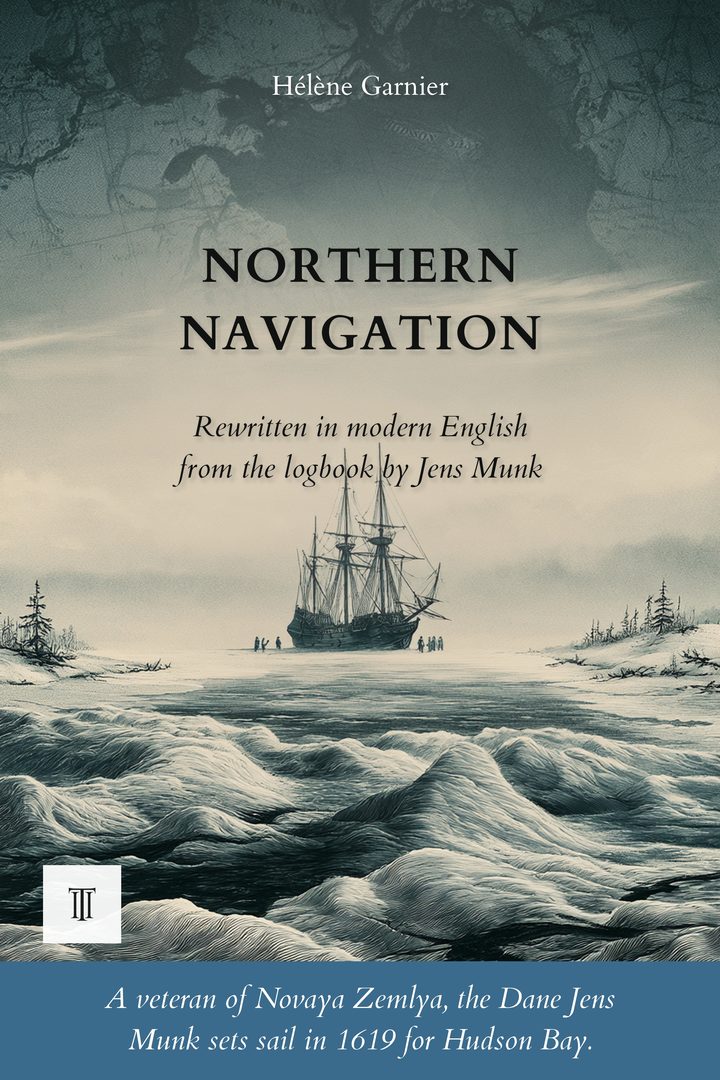
Born near Quebec, Nicolas Jérémie arrives at Hudson Bay in 1694 with Iberville as interpreter and clerk at Fort Bourbon, on the west coast. Taken prisoner by the English, he comes back, serves again, then commands the post from 1708 to 1714, before handing it over to the English after the Treaty of Utrecht. His Relation, published in Amsterdam in 1720, describes the rivers, animals and peoples of the bay. In it one reads the name "Danish River," given to the Churchill in memory of Munk's expedition: a century later, the Danish wintering was still written into the geography of the place.
Read a free edition → -
Henry Maundrell, A Journey from Aleppo to Jerusalem at Easter, A.D. 1697 (1697)
Chaplain to the English merchants of Aleppo, Henry Maundrell sets out in February 1697 with some fifteen companions to spend Easter in Jerusalem. He follows the Syrian and Lebanese coast through Sidon, Tyre and Acre, the very ports where Bénard landed and later re-embarked, before climbing to the Holy City and returning by Damascus and Baalbek. A Protestant, he watches the ceremonies of the Holy Sepulchre with an irony Bénard would not have understood, but he measures distances and describes ruins with an accuracy that made his small book, published in Oxford in 1703 and translated into French as early as 1705, a travelling companion for the next century's visitors.
Read a free edition → -
William Dampier, Nouveau voyage autour du monde (1697)
Having left England in 1679, William Dampier spent twelve years at sea among the buccaneers: the Isthmus of Panama, the coasts of Peru, the crossing of the Pacific, the Philippines, and in January 1688 a landfall on the north-west coast of New Holland, present-day Australia, whose inhabitants he describes with a harshness that would long be remembered. Back in London in 1691, he published in 1697 an account that enjoyed immense success. While Pastorius clears his acres and weighs every word of his letters, the other face of the English Atlantic roams the seas: that of the pirates and privateers who, precisely, intercept the mail from Germantown.
Read a free edition → -
William Dampier, A Continuation of a Voyage to New Holland (1699-1700)
Fifty-six years after Tasman, the former buccaneer William Dampier commands a worm-eaten ship, the Roebuck, for the English Admiralty and takes up the coast of New Guinea again. Where Tasman thought he was following a single continuous shore, Dampier discovers a passage and names the land it separates Nova Britannia. He observes the volcanoes, the canoes, the villages, with a naturalist's curiosity that the Dutch commander's journal lacked. The two accounts answer each other: Tasman follows a coast he believes to be one, Dampier discovers that it is an archipelago, and the map of Melanesia begins to take its modern shape.
Read a free edition → -
Gaspar de San Bernardino, Itinéraire de l'Inde à Portugal par terre (c. 1606)
A Portuguese Franciscan who around 1606 came home from the Indies by the overland route through Persia and Anatolia, San Bernardino offers the reverse of Pyrard's journey: no longer the sea and its shipwrecks, but caravans, deserts and inland cities. Together, sea and land trace the two great routes by which Europe then reached Asia.
-
Pierre-Esprit Radisson, Voyages (c. 1669)
The other end of the world, other solitudes. Radisson roams the Great Lakes and Hudson Bay in the 1650s and 1660s, captured by the Iroquois, adopted, escaped, a coureur de bois who passes into English service. His pages speak of the same world as Bourges's, one where an isolated European has no safety but his ability to make friends. In one, camels and caravanserais; in the other, canoes and portages; but everywhere the same lesson: the man who travels alone depends entirely on those he meets.