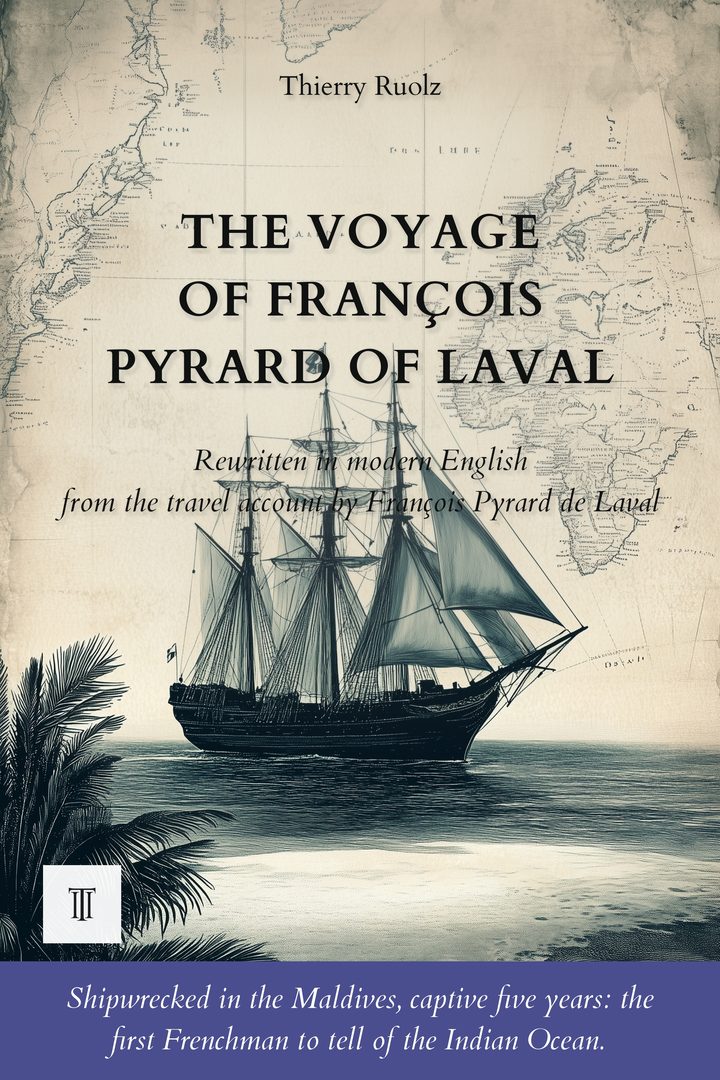
 East Indies · Modernised and illustrated edition
The Voyage of François Pyrard of Laval
Modernized, illustrated English edition of The Voyage of François Pyrard of Laval (Discours du voyage des François aux Indes orientales) by François Pyrard de Laval (1601-1611).
Shipwrecked in the Maldives, captive five years: the first Frenchman to tell of the Indian Ocean.
Read more ↓- 256 pages
- Paperback
- English
- 17th century
Countries covered: Maldives · India · Brazil · Indonesia · Iran · Equatorial Guinea · St. Helena · South Africa · Madagascar · Comoros · Bangladesh · Sri Lanka · Malaysia · Spain
About this book
Saint-Malo, 18 May 1601. A young man from Laval sets sail aboard the Corbin for the East Indies. He will return ten years later, having nearly circled the globe and survived everything. The shipwreck first throws him onto the reefs of the Maldives, where he will spend five years as the captive of an island king, learning the language and observing the court, the justice and the customs of an archipelago of twelve thousand islands.
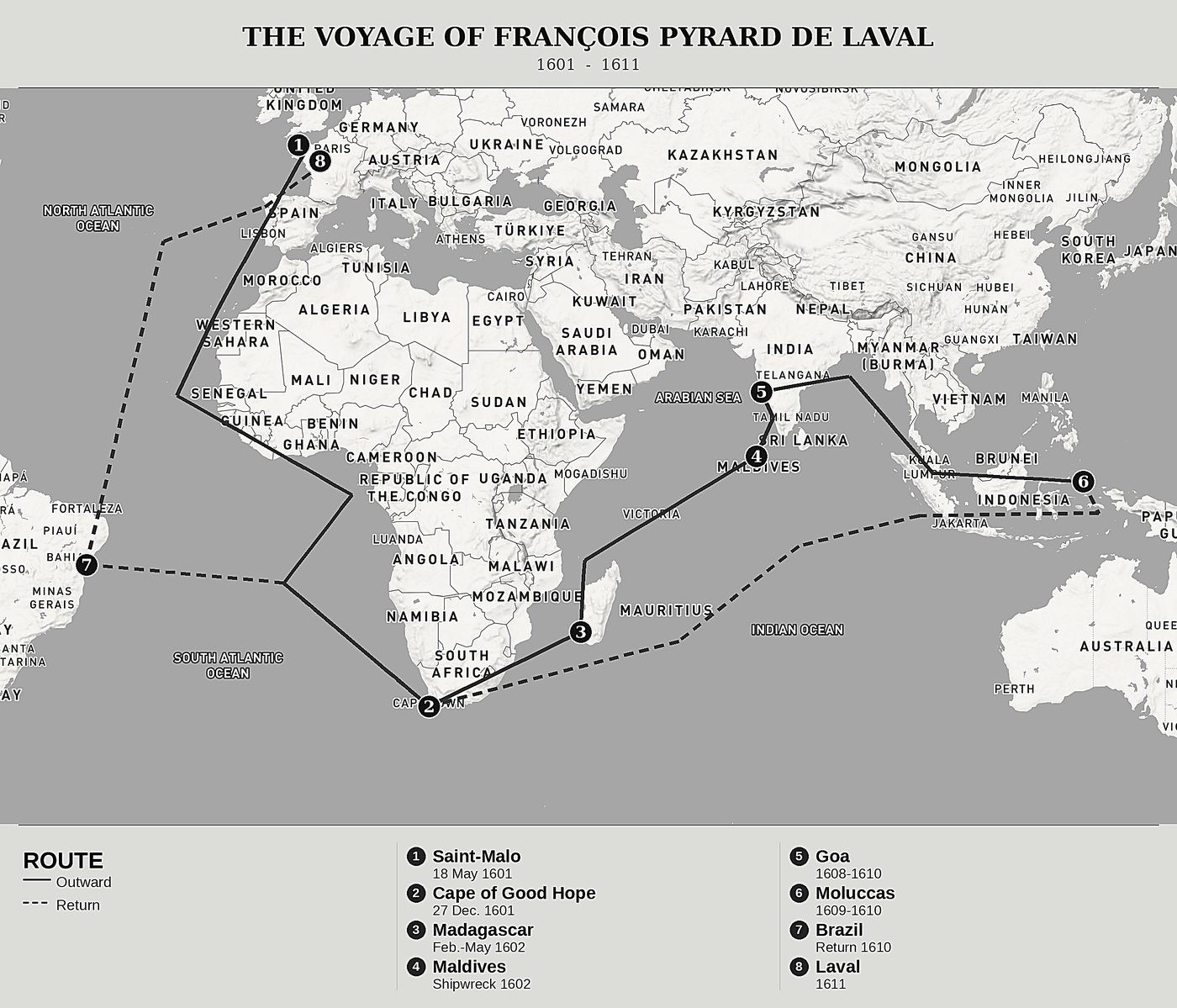
Then everything follows in turn: the invasion from Bengal that gives him back his freedom, the Nayar kings of Malabar and their warrior castes, his arrest at Cochin and imprisonment, the tower of irons, golden Goa and its dungeons, the Spice Islands of the Moluccas, and at last the long voyage home by the Cape of Good Hope, Brazil and Galicia. From these ten years of ordeals, tossed from jail to jail and from shipwreck to captivity, François Pyrard brings back far more than an adventure story.
It is the first French description of the Indian Ocean seen from within, a vivid encyclopedia of men, beasts and trees. Pyrard sets down the religion and justice of the Maldives, the rhythm of the monsoons that opens and closes the seas, the shell money and the silver larins, the coconut palm that feeds, clothes, shelters and quenches thirst, the ships stitched with fibre without a single iron nail. He lingers over the spices, the war elephants and the prodigious trees of the Indian continent. Pyrard is neither conqueror nor merchant: he is the castaway, the captive, the one who looks at this world from below, living among the peoples on whom he depends to survive. From this comes the patient curiosity, almost free of contempt, that makes him astonishingly close to us still.
The first Frenchman to tell of this world from the inside, Pyrard left one of the most striking testimonies of the age of the great crossings, halfway between a ship's log, an ethnographic inquiry and a tale of survival.
A complete rewrite in modern English for today's reader, which at last makes this tale of shipwreck and captivity readable without betraying anything of the voyage. Twenty original illustrations and eight maps of the voyage let readers see the route, while a set of aids to reading (a glossary of period terms, a chronology, an index of persons and an afterword) and selected passages of the original text shed light on the book.
Product details
- Publisher
- Itinerarium Éditions
- Series
- East Indies
- The author
- François Pyrard de Laval
- Date of the journey
- 1601-1611
- Modern edition by
- Thierry Ruolz
- Language
- English
- Format
- Paperback, 6 × 9 in (15.2 × 22.9 cm)
- Pages
- 256
- ISBN
- 979-10-985559-9-2
The author
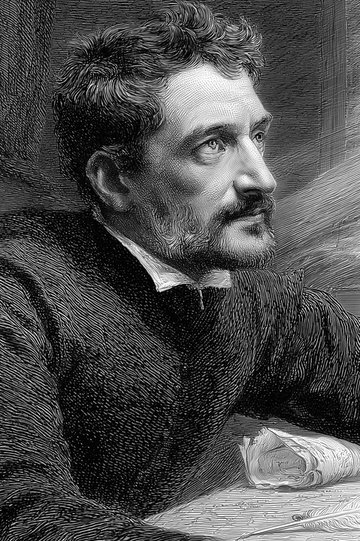
François Pyrard de Laval
François Pyrard de Laval (c. 1570 - c. 1621), born in Laval into a modest family of western France, sailed in 1601 aboard the Corbin, one of the first French ships to attempt the route to the East Indies. Shipwrecked in the Maldives in 1602, he lived there five years as a captive before a long journey through Bengal, Malabar, Cochin, Goa and the Moluccas, and a return by way of Brazil. From these ten years he brought back the first French testimony on the world of the Indian Ocean, seen from within. His Discours du voyage des François aux Indes Orientales, published in Paris in 1611, remains a unique document on maritime Asia in the early seventeenth century.
All books by François Pyrard de Laval →The journey mapped
In the Same Place, Through the Centuries
-
Jean-Baptiste Tavernier, Les Six Voyages (1676)
Half a century after Pyrard, the gem merchant Tavernier travels through the India of diamonds and princely courts.
-
François Bernier, Voyage dans les États du Grand Mogol (1670-1671)
Physician and philosopher, Bernier lived nearly twelve years in seventeenth-century India and describes it with a scholar's eye.
-
Robert Knox, Relation de l'île de Ceylan (1681)
An English sailor held prisoner for nearly twenty years in Ceylon, close to the Maldives, Knox wrote in the following century a captivity narrative that strangely echoes Pyrard's: the same forced apprenticeship in a language and…
-
Le Gentil de la Galaisière, Voyage dans les mers de l'Inde (1779-1781)
An astronomer sent to observe the transit of Venus in the eighteenth century, Le Gentil failed in his calculations but, by chance, achieved a long crossing of the same waters Pyrard had known two centuries earlier.
The modern editor

More in this series
See all →