 Far North · Modernised and illustrated edition
The History of Lapland
Modernized, illustrated English edition of The History of Lapland (Lapponia) by Johannes Schefferus (1673).
The first great treatise on the Sámi: language, shamanism and survival in the heart of the Arctic.
Read more ↓- 498 pages
- Paperback
- English
- 17th century
About this book
In 1673, from his study in Uppsala, the Alsatian scholar Johannes Scheffer published in Latin a book that would open to Europe an unprecedented window onto one of the continent's least known peoples: the Sámi of the Far North.
He had never seen Lapland. He reconstructs it from the letters sent to him by pastors posted on the icy edges of Sweden, which he cross-checks against the ancient authors and his own learning. From this patient inquiry comes the first great European description of a world of snow, reindeer and tents.
We follow the origins of a nation come out of the cold, the faith of its ancient gods, the cross advancing northward, the shaman's drum questioning the spirits, the laws and the tribute, the silent trade, the language, weddings, hunting, the reindeer that sustains a whole people. At the heart of the story, a man, Petrus Paejwiae, burns the sacred stone of his fathers: a world tips over.
Three and a half centuries later, this book remains the most precise window ever opened onto a people long withdrawn into the silence of the North.
A complete rewrite in modern English of the description "Lapponia, id est, Regionis Lapponum et gentis nova et verissima descriptio" by Johannes Scheffer, 1673, including maps and illustrations.
Product details
- Publisher
- Itinerarium Éditions
- Series
- Far North
- The author
- Johannes Schefferus
- Date of the journey
- 1673
- Modern edition by
- Erik de Boisgrollier
- Language
- English
- Format
- Paperback, 6 × 9 in (15.2 × 22.9 cm)
- Pages
- 498
- ISBN
- 979-10-985559-4-7
The author
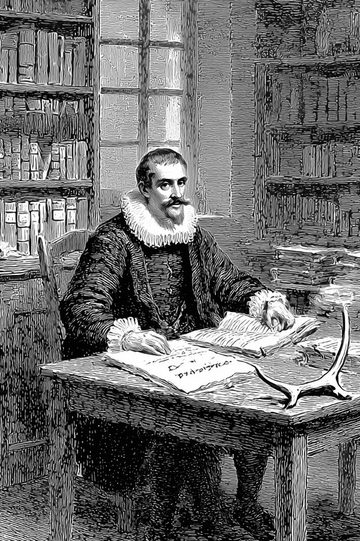
Johannes Schefferus
Johannes Scheffer (1621-1679), born in Strasbourg into a family of scholars, was one of the great humanists of the seventeenth century. Professor of eloquence and politics at Uppsala University and keeper of the Swedish royal library, he published the Lapponia in 1673, the first European description devoted to the Sámi. Working on commission from Chancellor Magnus Gabriel De la Gardie, he combined the manuscripts of Lutheran pastors, confiscated shamanic drums and the testimony of Sámi students to compose a description of unprecedented precision. Translated into English, German, French and Dutch soon after its appearance, the work remains, three and a half centuries later, the richest source on ancient Sámi civilisation.
All books by Johannes Schefferus →The journey mapped
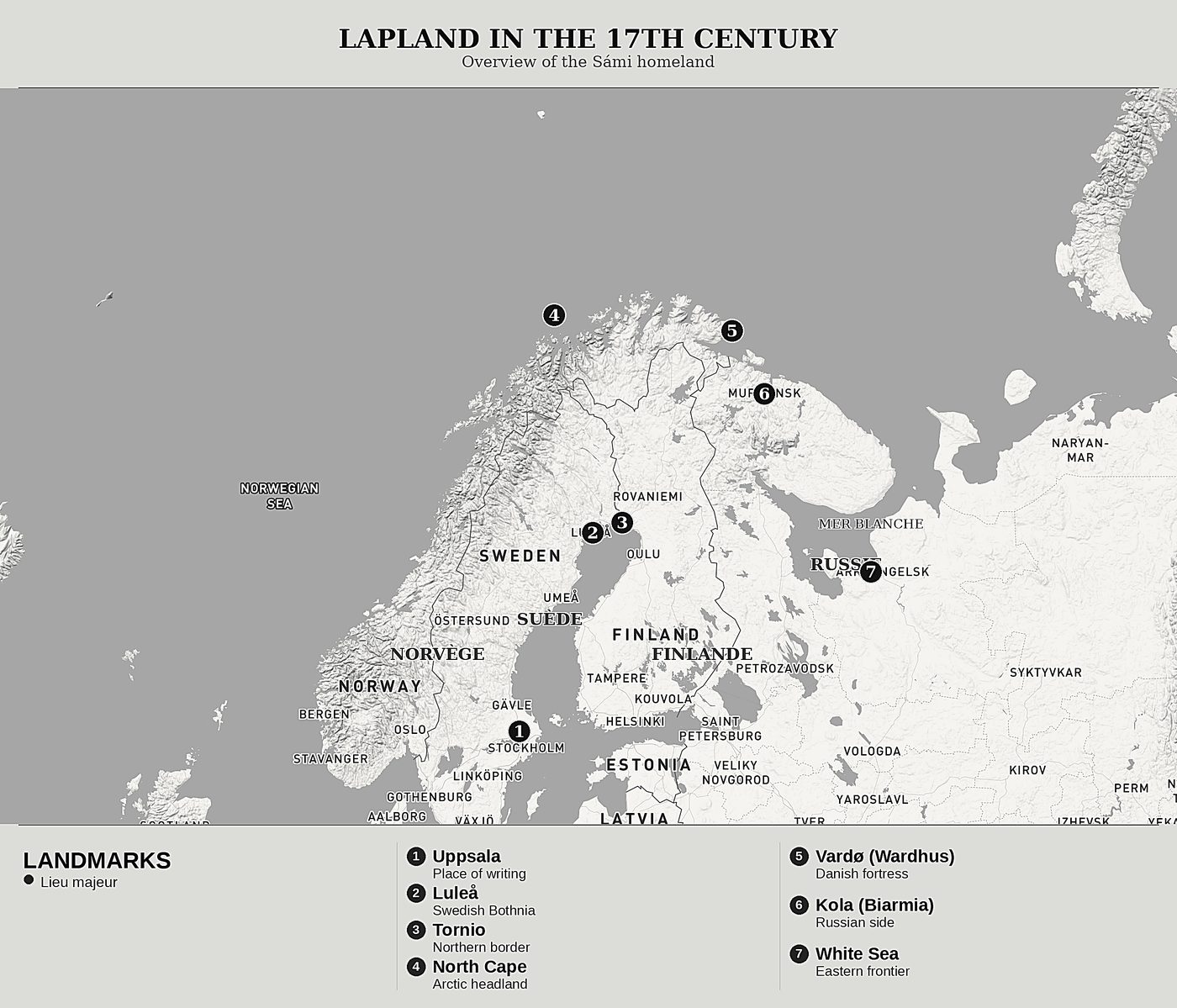
In the Same Place, Through the Centuries
-
Pierre Louis Maupertuis, La figure de la Terre (1738)
In 1736 the Academy of Sciences sends Maupertuis to measure a degree of meridian under the Arctic Circle, in the Tornio valley that Scheffer had known only through letters.
Our edition → -
Giuseppe Acerbi, Voyage au cap Nord (1802)
At the turn of the nineteenth century, an Italian travels up Scandinavia to the extreme tip of the continent, where Scheffer placed the limits of the known world.
-
Xavier Marmier, Lettres sur le Nord (1840)
A romantic and learned traveller, Marmier journeyed through Scandinavia around 1840 and brought back from Lapland pages where emotion competes with observation.
-
Paul-Émile Victor, Boréal
Much later, a Frenchman goes to live among the peoples of the Arctic and returns with an account of immersion.
The modern editor

More in this series
See all →