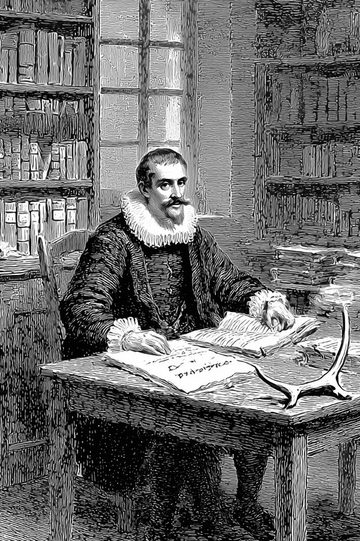
Biography
Johannes Scheffer (1621-1679) was one of the leading scholars of seventeenth-century Sweden, a professor at Uppsala University for more than thirty years. In 1673 he published the Lapponia, a Latin description of northern Scandinavia and its inhabitants, the Sámi. Written on political commission, by an author who had never set foot in Lapland, the book is nonetheless the first overall synthesis devoted to this people and remains one of the most consulted sources on its ancient culture.
Born in Strasbourg on 2 February 1621, in a free city of the Holy Roman Empire, he belonged to a patrician family, the Scheffers. He studied at the university of his home town, then briefly at Leiden, before being called to Sweden in 1648. Queen Christina was then drawing foreign scholars to give her kingdom a European intellectual standing. Scheffer received there the so-called Skyttean chair of eloquence and politics, founded by the statesman Johan Skytte to train future administrators and diplomats, and he held it until his death. A philologist, archaeologist and historian of literature, he published, among other works, Upsalia (1666), De re vehiculari veterum (1671) and, posthumously, the Suecia literata (1680), the first directory of Swedish learned authors. He died in Uppsala on 26 March 1679.
The Lapponia arose from a commission by Chancellor Magnus Gabriel De la Gardie. Pamphlets published in Germany during and after the Thirty Years' War accused the Swedish armies of owing their victories to Sámi magic. The government wished to answer them with an accurate, verifiable description. Scheffer therefore worked in Uppsala, without travelling, from reports written at his request by the Lutheran pastors of the northern parishes, known as the ecclesiastical correspondence, from older printed sources, from objects gathered in Uppsala, including confiscated shaman drums, and from conversations with Sámi students, among them Olaus Sirma.
The book's thirty-five chapters deal with the origin and language of the Sámi, their dwellings, clothing, crafts, the division of tasks between men and women, reindeer herding, hunting, the upbringing of children, pre-Christian religion and shamanic practices, but also the metals, flora and fauna of northern Sweden. Two Sámi songs, or joiks, transmitted by Sirma, appear in the original language with a Latin translation; they are among the first Sámi texts ever printed. The Latin edition appeared in Frankfurt am Main at the end of 1673.
Success was immediate: an English translation in 1674 under the title The History of Lapland, a German one in 1675, a French one in 1678, a Dutch one in 1682. Abridgements later appeared in Germany and the Netherlands, which dropped the chapters on dwellings and the economy to keep only those on witchcraft and drums, illustrated with engravings supporting the diabolical character of these practices. The book meant to dispel a rumour thus ended up feeding it. The two joiks, for their part, were taken up in the eighteenth century by English and German writers and passed into European poetry. The full text was not translated into Swedish until 1956. Historians now read it on two levels: as an indirect but rich testimony on seventeenth-century Sámi society, and as a document on the gaze that the Swedish state and learned Europe then cast upon it.