Our titles on this subject
Further reading: accounts and works on the same theme
Accounts and works around this subject, in date order, to place our titles in context. Each links to a free online edition when one exists, or to our own page when the work is in our catalogue.
-
Hidalgo d'Elvas, Relation véridique des travaux du gouverneur Hernando de Soto (1539-1543)
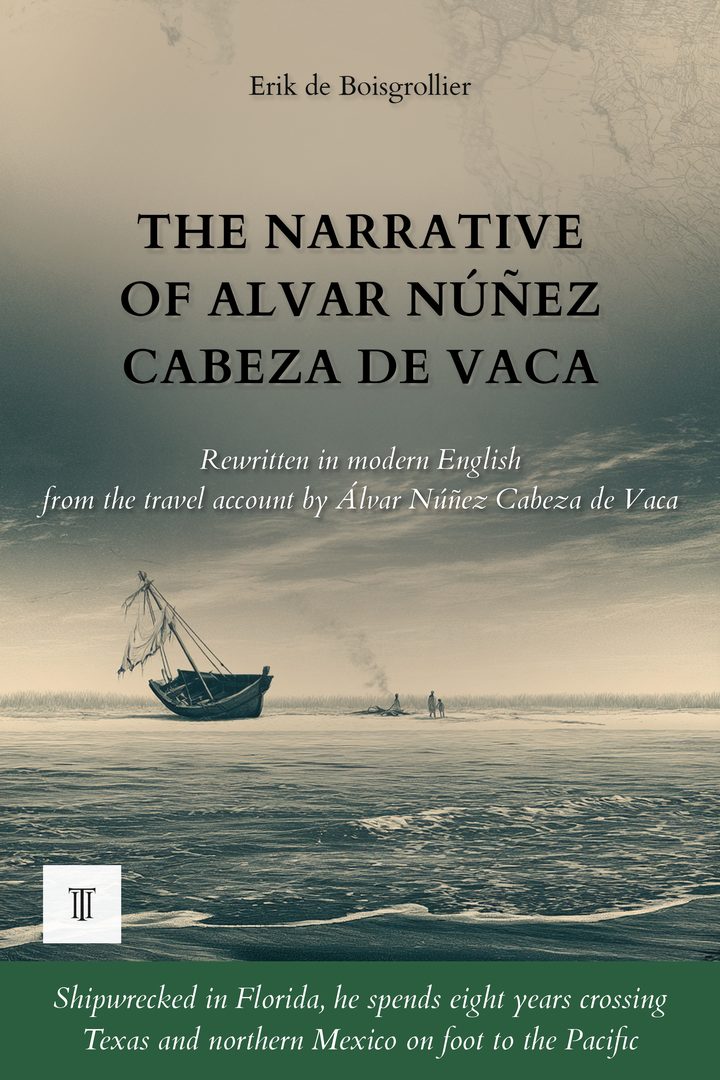
In the very year of Cabeza de Vaca's return, Hernando de Soto obtained Florida; he landed there in 1539, he too in the Tampa Bay area. His men wintered at Apalache, took in Juan Ortiz, a Spaniard who had come looking for Narváez and stayed more than ten years among the Indians, then wandered for four years through the Southeast. After Soto's death, the survivors built brigantines, went down the Mississippi and followed the coast to Pánuco, the port the boats of 1528 had never reached. An anonymous Portuguese knight published the account in Évora in 1557.
Read a free edition → -
Pedro de Castañeda de Nájera, Relation de l'expédition de Cíbola (1540-1542)
The stories of the four survivors set Mexico City dreaming of rich cities to the North. In 1539 Estevanico guided the Franciscan Marcos de Niza towards the seven cities of Cíbola and was killed there; the following year Coronado set out with an army. A common soldier, Castañeda told twenty years later of the stone villages of the Zuni, the Grand Canyon, the plains covered with bison, the humpbacked cows Cabeza de Vaca had described, and the elusive Quivira. The mirage of Apalache repeats itself further west, with the same disappointment.
Read a free edition → -
Jean-Baptiste Tavernier, Les Six Voyages (1676)
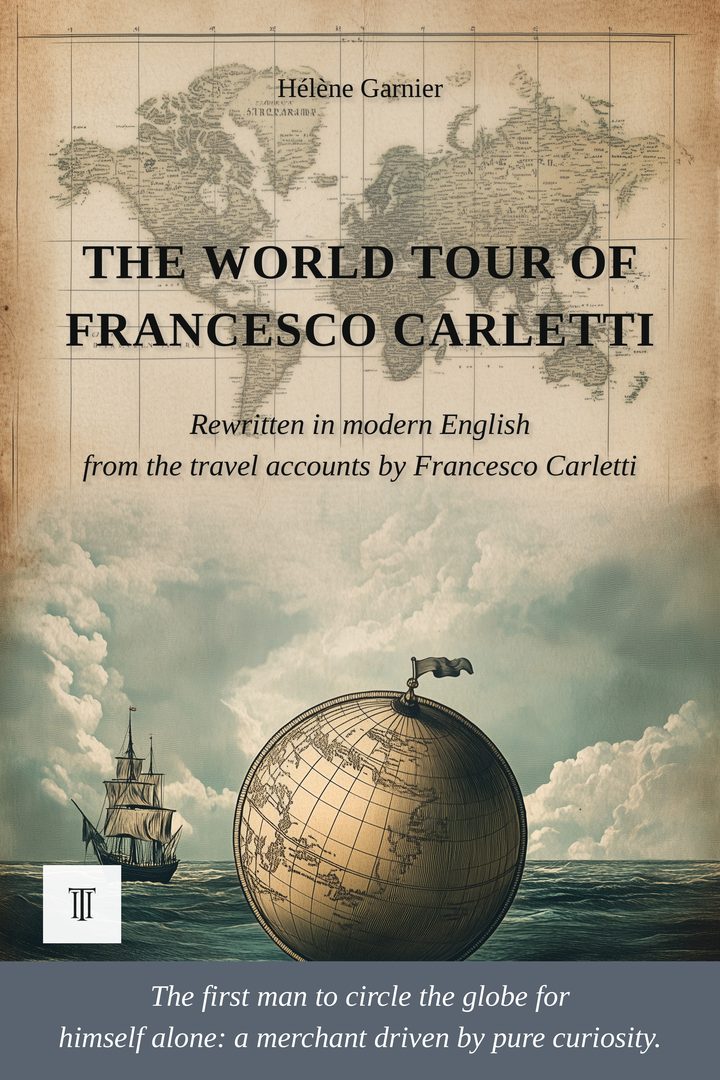
Half a century after Carletti, this dealer in precious stones travels in turn through Persia and India, from the diamond mines to the courts of great kings. In him we find the same trader's eye for gems, currencies, and routes as in the Florentine, but Asia has already changed: the Dutch and English whom Carletti saw only beginning to appear at Goa are now installed there as masters of trade.
-
Henri Joutel, A Journal of the Last Voyage Perform'd by Monsr. de La Sale (1684-1687)
In 1685 Cavelier de La Salle was looking for the mouth of the Mississippi, missed it as Narváez's boats had missed it, and landed on the coast of Texas, near Matagorda Bay. Fort Saint-Louis wasted away there through disease, shipwrecks and desertions, until La Salle was murdered by his own men in 1687. Joutel, one of the few survivors, made his way on foot to Arkansas and Illinois, then returned to France. His journal, published in 1713, describes these low coasts, their lagoons and their peoples, a century and a half after Cabeza de Vaca passed through.
-
Engelbert Kaempfer, Histoire naturelle, civile et ecclésiastique du Japon (1690-1692)
A physician for the Dutch East India Company, Kaempfer lived in Japan at the close of the seventeenth century, in a country now closed to foreigners and purged of Christians. His book shows what became of the Japan that Carletti had reached while it was still open, before the crosses of Nagasaki announced the great closing. The same archipelago, a century later, locked shut.
-
Gemelli Careri, Le Tour du monde (1699-1700)
At the close of the seventeenth century, this Neapolitan magistrate retraces, as a well-off tourist, the circuit of the globe that Carletti had accomplished as a ruined merchant. Manila, Acapulco, Mexico City: he follows almost the same route and publishes an account that will meet with immense success. Reading Gemelli after Carletti is to measure the distance travelled between perilous adventure and pleasure travel.
-
Amédée-François Frézier, Relation du voyage de la mer du Sud aux côtes du Chili et du Pérou (1716)
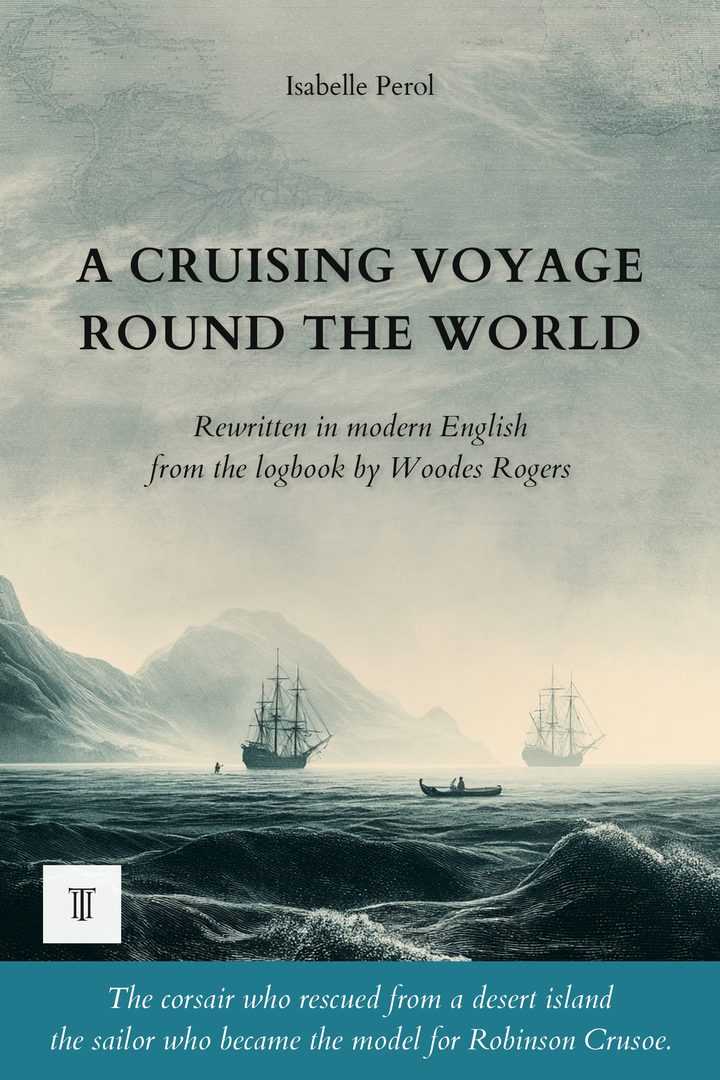
Three years after Rogers, the military engineer Frézier sets out for the South Sea disguised as a merchant captain. From 1712 to 1714, from Concepción to Valparaíso, from Callao to Arica, he secretly draws up plans of the ports, counts the Spanish guns and garrisons, and observes the mines and the crops. He brings back to France the Chilean strawberry plant, which will give us our garden strawberries. His account appears in Paris in 1716 and an English translation follows as early as 1717. It covers the coast that Rogers sails up, seen this time by an officer's eye, attentive to defences more than to booty. The book is Relation du voyage de la mer du Sud aux côtes du Chili et du Pérou.
-
Richard Walter, A Voyage Round the World by George Anson (1748)
Thirty years later, Commodore Anson's squadron almost retraces the route of the Duke. Setting out in 1740 and decimated by scurvy off Cape Horn, it recovers at Juan Fernández, where the sailors find goats with slit ears that they link to Selkirk. It plunders Paita, watches in vain for the galleon off Mexico, then in 1743 seizes the Covadonga near the Philippines. The narrative, published in 1748 under the name of the chaplain Richard Walter, becomes a great publishing success. It shows what naval war made of Rogers's privateering model. See A Voyage Round the World by George Anson.
Read a free edition → -
Louis-Antoine de Bougainville, Voyage autour du monde par la frégate du roi La Boudeuse et la flûte L'Étoile (1771)
Setting out in 1766 to hand the French settlement on the Falklands over to the Spanish, Bougainville passes through the Strait of Magellan, crosses the Pacific by way of Tahiti, Samoa, the New Hebrides and the Solomons, then reaches the Moluccas and Batavia before returning across the Indian Ocean. It is the first official French naval voyage round the world. His account, published in 1771, feeds the philosophers' debate on the noble savage. The comparison with Rogers is telling: the same seas, the same Dutch ports of call, but a voyage of state, of scholars and observation, where Rogers led an enterprise of prizes. The book is Voyage autour du monde par la frégate du roi La Boudeuse et la flûte L'Étoile.
Read a free edition → -
William Bartram, Travels through North and South Carolina, Georgia, East and West Florida (1773-1777)
Two and a half centuries after Narváez's march, the Philadelphia naturalist travelled the Floridas on horseback and by canoe, from the St. Johns River to the Alachua savanna, then reached the Gulf coast towards Mobile and the Mississippi. He drew the plants, the alligators, the cranes, and described the towns of the Creeks and Seminoles with respect. Where the men of 1528 saw only lagoons, fallen trees and archers lying in ambush, Bartram saw a garden. Published in 1791, his Travels fed the imagination of Coleridge and Wordsworth.
Read a free edition → -
Alexander von Humboldt, Voyage aux régions équinoxiales du Nouveau Continent (1799-1804)
Two centuries after Carletti, the Prussian scholar explores New Spain and Peru with the instruments of modern science. Where the merchant noted the prices of cacao and silver, Humboldt measures, classifies, and understands. The same lands, seen through an Enlightenment mind, shed light in return on the still-groping curiosity of the Florentine traveler.
-
Charles Darwin, Journal of Researches (1839)
Aboard the Beagle from 1831 to 1836, Darwin in his turn skirts Brazil, touches the Falklands, rounds Cape Horn, stays in Chile and Peru, then spends five weeks in the Galápagos in September 1835, before returning by the Cape. Where Rogers sought fresh water and tortoises to feed his crews, the young naturalist notes the differences from island to island among the finches and the giant tortoises. His journal, published in 1839, changes the way these archipelagos are seen, which the Bristol privateers took for dry and useless rocks. See Journal of Researches.
Read a free edition → -
John Russell Bartlett, Personal Narrative of Explorations and Incidents in Texas, New Mexico, California, Sonora, and Chihuahua (1850-1853)
Appointed American commissioner to survey the new border after the war with Mexico, Bartlett spent three years between Texas, New Mexico, Chihuahua and Sonora. He followed the Rio Grande, crossed the dry sierras, visited the towns and missions of Sonora, and drew the landscapes and the peoples. Published in 1854, his narrative covers almost exactly the last stretch of the four survivors' route, from the villages of the Rio Grande to the shore of the South Sea, at the moment this land was being divided between two states.
-
Frederick Law Olmsted, A Journey Through Texas (1853-1854)
Before designing Central Park, Olmsted crossed Texas on horseback with his brother in the winter of 1853-1854. He describes the coastal plain, the German settlers of New Braunfels, San Antonio, the ranches, and pushes on to the Rio Grande and beyond, into Mexico. His book, published in 1857, is also an indictment of the slavery spreading through the new state. Where Cabeza de Vaca had walked naked from nation to nation, Olmsted finds a land filling up with farms, and observes what colonisation does to people.
-
Herman Melville, Les Encantadas ou îles enchantées (1854)
In 1841 the whaler Acushnet sails past Albemarle Island, in the Galápagos, with a young sailor named Herman Melville aboard. Thirteen years later, under the pseudonym Salvator R. Tarnmoor, he publishes in Putnam's Monthly ten sketches of these islands of ash and lava, peopled by tortoises, hermits and former buccaneer lairs. He cites the old buccaneer accounts, such as Cowley's, by sailors who, before and after Rogers, came there for tortoises. The text, reprinted in 1856 in The Piazza Tales, turns into a moral landscape the archipelago that Rogers's journal describes as a hurried seaman. The sketches are The Encantadas, or Enchanted Isles.
Read a free edition →