Our titles on this subject
Further reading: accounts and works on the same theme
Accounts and works around this subject, in date order, to place our titles in context. Each links to a free online edition when one exists, or to our own page when the work is in our catalogue.
-
Peter Füssli, Voyage à Jérusalem en 1523 et lettre sur la chute de Rhodes (1523)
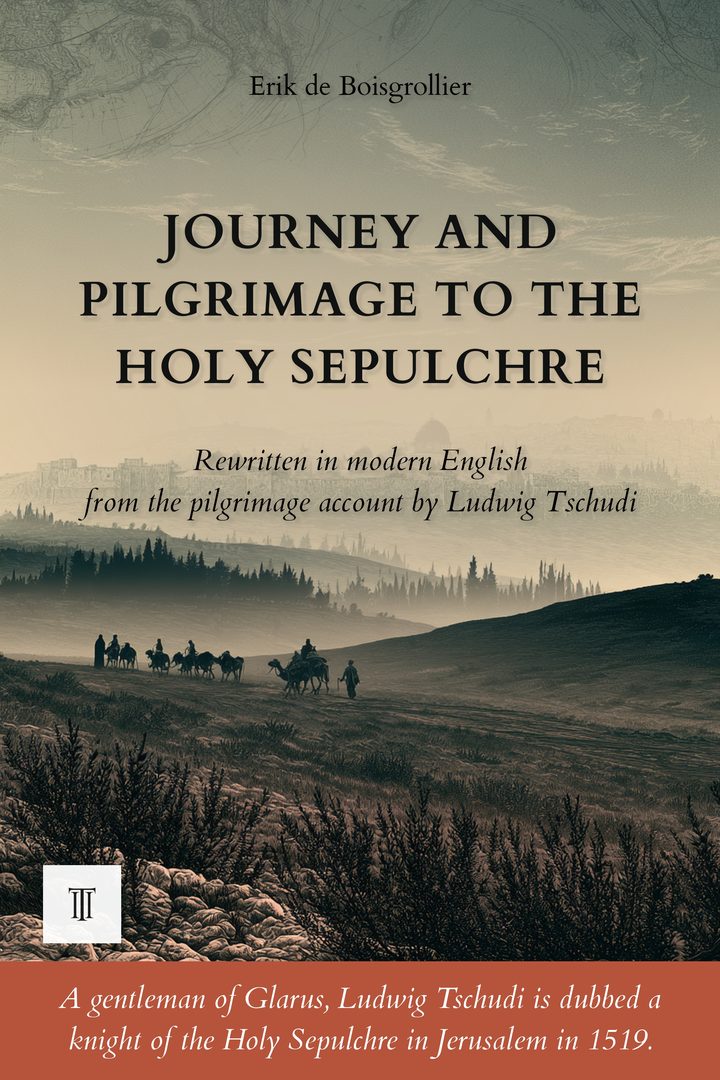
Four years after Tschudi, another Confederate takes the road to the Holy Sepulchre: the Zurich bell and cannon founder Peter Füssli, a former captain of the Italian wars and a member of his city's Great Council. His account of 1523, drier than the Glarus man's, follows the same pilgrim route through Venice, but it comes with a letter on the fall of Rhodes, taken by Suleiman the Magnificent at the end of 1522: the island where Tschudi had Peter Falck and Melchior zur Gilgen buried is now Ottoman, and its knights have gone. Füssli's two texts were edited together in 1982, and reading them directly extends Tschudi's retrospective aside on Rhodes.
-
Pierre Belon, Les Observations de plusieurs singularités et choses mémorables (1546-1549)
The naturalist Pierre Belon of Le Mans set out in 1546 in the retinue of the French embassy to Suleiman and returned only in 1549. His Observations, published in 1553, lead the reader through Greece, Crete, Constantinople, Egypt and the Holy Land, but with a different eye from Tschudi's: Belon notes plants, fish, snakes, remedies and trades, and describes people more than relics. A generation after the Glarus pilgrim, the eastern Mediterranean becomes a field of learned inquiry, and the road to Jerusalem a path for the curious as much as for the devout. The stopovers at Candia and Rhodes take on quite a different aspect there.
-
Leonhard Rauwolf, Description véritable du voyage en Orient (Aigentliche Beschreibung der Raiß) (1573-1576)
A physician and botanist from Augsburg, Leonhard Rauwolf sailed from Marseille in 1573 on behalf of a trading house, lived nine months in Aleppo, went down to Baghdad, then, recalled by the bankruptcy of his backers, made the pilgrimage to Jerusalem in 1575 before returning by way of Venice in early 1576. His account, printed at Lauingen in 1582, is a herbarium as much as a diary; in it one reads one of the first European descriptions of coffee. Like Tschudi, Rauwolf writes in German for readers who stayed at home, but he discovers a Holy Land where the Ottoman administration, still brand new in 1519, has been in place for more than half a century.
-
Michel de Montaigne, Journal de voyage en Italie (1580-1581)
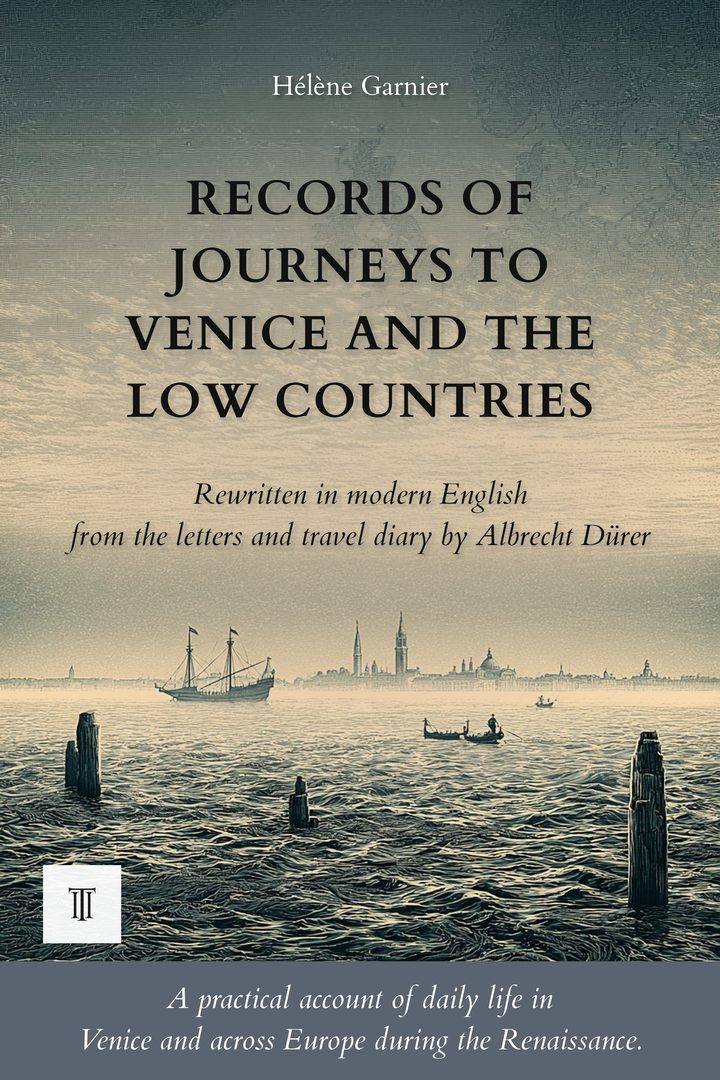
Three quarters of a century after Dürer, Montaigne crosses Switzerland and Germany on his way to Italy and stops for a week in Venice in November 1580. He finds the city less marvellous than he had imagined, observes its institutions, its policing and its courtesans, and receives a book of letters from Veronica Franco. The journal, partly dictated to a secretary, was not rediscovered and published until 1774. In it we find what Dürer described from the inside: a city that welcomes the stranger with curiosity and a little mistrust, and a traveller from the North who measures, with irony, what he has gained and lost by leaving home.
Read a free edition → -
Thomas Coryat, Coryat's Crudities (1608)
In 1608, an eccentric from Somerset set off on foot across France and Italy, spent six weeks in Venice, then returned to England through Switzerland, along the Rhine and across the Low Countries. His Crudities, published in 1611, offer one of the liveliest English descriptions of Venice: Saint Mark's Square, the gondolas, the courtesans, the Doge's Palace, and the Italian use of the fork, which he reports as a curiosity. On the Rhine he travels almost the same river as Dürer, from Mainz to Cologne, and then crosses the Dutch provinces. His jesting, boastful tone sometimes recalls Dürer's letters to Pirckheimer a century earlier, when the painter mocked the friends he had left behind in Nuremberg.
Read a free edition → -
George Sandys, A Relation of a Journey begun An. Dom. 1610 (1610-1611)
In 1610 the English poet George Sandys leaves Venice on a long journey through the Ottoman Empire: Constantinople, Egypt and Sinai, Palestine, then Cyprus, before heading back by way of Sicily, Naples and Rome. His Relation, published in 1615 and often reprinted, describes the Holy Sepulchre, the Christian communities that share its chapels and the pilgrims who came from all over Europe. Less than a century after Tschudi, the setting has changed little, with its Franciscans, its taxes and its escorts, and the itinerary still runs through Venice and Cyprus; but the eye is that of a learned Protestant, attentive to antiquities and more sceptical of relics than the gentleman of Glarus.
Read a free edition → -
Jean de Thévenot, Relation d'un voyage fait au Levant (1664)
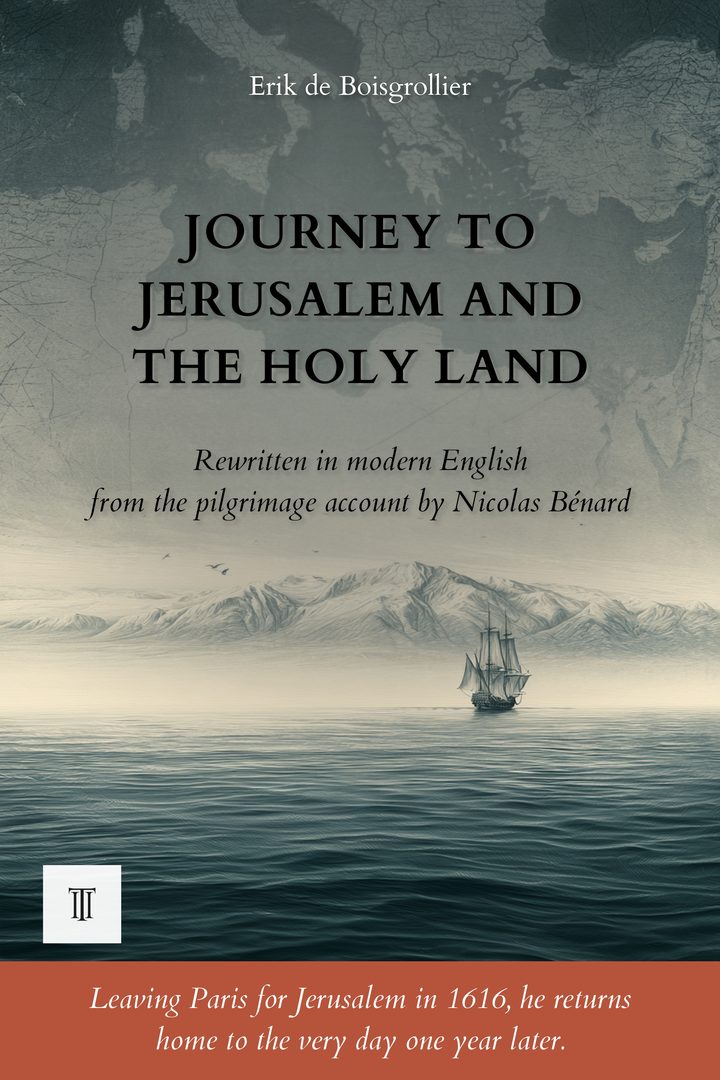
Forty years after Bénard, another young Parisian sets out for the Levant, in 1655. Jean de Thévenot spends several years in Constantinople, Egypt and the Holy Land, where he too receives the knighthood of the Holy Sepulchre. But where Bénard counts indulgences, Thévenot observes customs, coins, coffee houses and caravans with the curiosity of a traveller rather than a pilgrim. His account appeared in 1664 and was often reprinted. He then left again for Persia and India and died on the way home, in 1667. The two books show how, within a generation, pilgrimage turns into a journey of observation.
Read a free edition → -
Henry Maundrell, A Journey from Aleppo to Jerusalem at Easter, A.D. 1697 (1697)
Chaplain to the English merchants of Aleppo, Henry Maundrell sets out in February 1697 with some fifteen companions to spend Easter in Jerusalem. He follows the Syrian and Lebanese coast through Sidon, Tyre and Acre, the very ports where Bénard landed and later re-embarked, before climbing to the Holy City and returning by Damascus and Baalbek. A Protestant, he watches the ceremonies of the Holy Sepulchre with an irony Bénard would not have understood, but he measures distances and describes ruins with an accuracy that made his small book, published in Oxford in 1703 and translated into French as early as 1705, a travelling companion for the next century's visitors.
Read a free edition → -
Johann Wolfgang von Goethe, Voyage en Italie (1786-1788)
In September 1786, Goethe slipped away from Karlsbad in secret and made his way south to Italy. He spends just over two weeks in Venice, climbs the campanile of Saint Mark's, watches the boats, discovers the sea, hurries through Palladio's churches and the paintings of the Venetian masters, and attends the pleadings in court and the popular theatre. It is the founding account of the German journey to Italy, that of a Northerner who comes in search of a personal renaissance. Almost three centuries earlier, Dürer had already taken this road and felt the same thing, in rougher language: in Venice he is treated as a gentleman, and he fears becoming, at home, a mere parasite again.
Read a free edition → -
Chateaubriand, Itinéraire de Paris à Jérusalem (1806-1807)
In 1806 Chateaubriand leaves Paris for Jerusalem by way of Greece, Constantinople and Rhodes, lands at Jaffa and goes up to the holy city, where the Father Guardian of the Franciscans dubs him a knight of the Holy Sepulchre with the sword attributed to Godfrey of Bouillon. The Itinerary from Paris to Jerusalem, published in 1811, makes this journey one of the great texts of French prose. Nearly three centuries separate the two dubbings, and reading it one gauges what has changed and what remains: the same roadstead at Jaffa, the same friars to welcome the pilgrim, the same ceremony, but a traveller who looks for ruins and memories as much as for indulgences.
Read a free edition → -
Alphonse de Lamartine, A Pilgrimage to the Holy Land (1832-1833)
In 1832 Lamartine sails from Marseille with his wife and his daughter Julia on a ship he has chartered, and reaches the coast of Lebanon. He visits Jerusalem in October, then returns to Beirut, where Julia dies in December. Published in 1835, the account mingles landscapes, encounters and a grief that darkens the whole journey. Bénard too had left from Marseille and landed at Sidon; but where he sees in Palestine only the traces of the Gospel, Lamartine looks there for a personal emotion and a reflection on the future of the East, at a time when the Ottoman Empire is faltering.
Read a free edition → -
Victor Hugo, Le Rhin (1838-1840)
Hugo travelled up the Rhine in the late 1830s and drew from it, in 1842, a book of letters to a friend. He stops at Aachen before the tomb of Charlemagne, contemplates the unfinished cathedral of Cologne, marvels at Bacharach, Sankt Goar and the ruined castles, and blends legend, history and European politics into the landscapes. It is almost exactly Dürer's route of 1520: the same toll towns, the same chapel of Charlemagne where the painter saw Charles V crowned, the same Cologne where he obtained his pension. Where Dürer counted the florins paid to the customs men, Hugo dreams before the ruins of a vanished Middle Ages.
-
Gérard de Nerval, Voyage en Orient (1843)
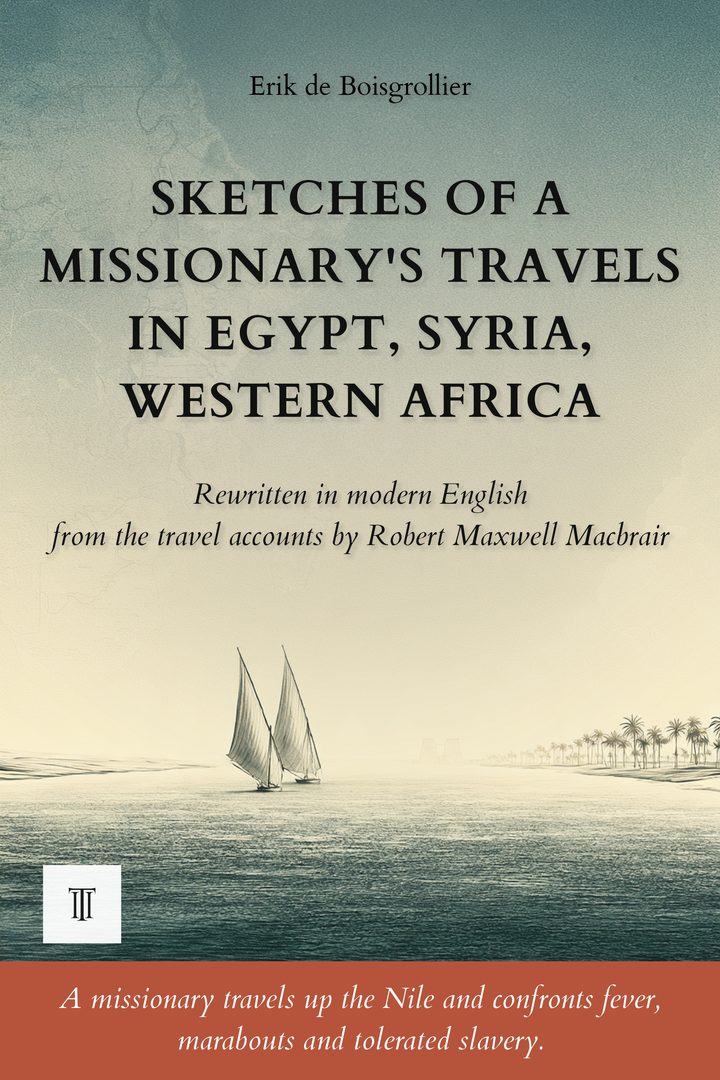
Nine years after Macbrair, Gérard de Nerval lands at Alexandria early in 1843 and settles in Cairo, where he rents a house, buys a Javanese slave girl and has the legend of the caliph Hakim told to him. He then travels on to Beirut and Mount Lebanon, at the heart of the rivalries between Druze and Maronites that Macbrair had already seen fermenting under Ibrahim Pasha. His Voyage en Orient, published in 1851, blends reportage, reverie and embedded tales. The contrast is complete: the poet seeks in the East a mystery to love, the missionary a people to save, yet both describe the same teeming city, its cafés, its markets and its alleys.
Read a free edition → -
Harriet Martineau, Eastern Life, Present and Past (1848)
Four years after Ida Pfeiffer, the Englishwoman Harriet Martineau, already famous for her writings on political economy, set out in turn for the East at the end of 1846. She goes up the Nile into Nubia, crosses Sinai, visits Petra, then Jerusalem, Galilee and Damascus. Like the Viennese woman, she travels as a mature woman, not letting the fatigues of the saddle and the tent stop her. But where Pfeiffer prays, Martineau reasons: her Eastern Life, Present and Past turns Egyptian temples and holy places into stages in a history of religions, to the point of scandalising some of her readers. Two women before the same stones, two ways of believing.
Read a free edition → -
Gustave Flaubert, Notes de voyages (1849-1851)
With Maxime Du Camp, Flaubert travels through Egypt, then Palestine, Syria, Rhodes and Constantinople between 1849 and 1851. He reaches Jerusalem in August 1850. His notebooks, published after his death and edited in 1910, were not meant for the public: brief notes, sensations, things seen, with no indulgence for the shrines or for the quarrels of the Christian communities at the Holy Sepulchre. They make striking reading after Bénard, who already described the division of the church among Latins, Greeks and Armenians, but with a believer's fervour. Flaubert looks there for the truth of things and finds above all disillusion.
Read a free edition → -
Gustave Flaubert, Voyage en Orient (1849-1851)
In November 1849, Gustave Flaubert, aged twenty-seven, sails from Marseille with Maxime Du Camp, who has been entrusted with a photographic mission. They ascend the Nile in a cangia as far as the Second Cataract, stop at Philae, Thebes and Esna, then go on to Beirut, Jerusalem, Damascus and Baalbek. The notes and letters from this journey, published after the writer's death, are raw, funny, sensual, with a painter's precision. Fifteen years after Macbrair, Flaubert follows almost the same route, from Cairo to the ruins of Baalbek, but with the eye of an artist who wants to see everything and judge nothing: the reader can set two views side by side, one pious, the other profane, of the same riverbanks.
Read a free edition → -
Thomas Eyre Poole, Life, Scenery, and Customs in Sierra Leone and the Gambia (1850)
Colonial and garrison chaplain at Freetown, the Reverend Thomas Eyre Poole published in London, in 1850, two volumes on Britain's West African colonies. From Sierra Leone he moves on to the Gambia, visits the settlements on the river and travels a long way up it. He depicts the life of the colonists, of the liberated Africans and of the riverside peoples, and dwells on the neglected churches, the cemeteries overrun by grass and the fevers that cut down Europeans, which he himself survives several times. The reader rediscovers the fragile colony, with its trading posts and missions, that Macbrair had known, seen this time by an Anglican clergyman rather than a Methodist.
Read a free edition → -
Herman Melville, Journal of a Visit to Europe and the Levant (1856-1857)
In December 1856, Herman Melville, exhausted by the failure of his last novels, arrives in the Levant. He sees Constantinople, the pyramids of Giza, then Jaffa and Jerusalem in January 1857, before returning by Beirut, Greece, Naples and Rome. His Journal of a Visit to Europe and the Levant, kept in rapid notes, is dark: Judea seems to him a landscape of stones and desolation, far from the Promised Land. The reader of Pfeiffer finds the same stages here, from the Bosphorus to Vesuvius, but seen by a man who seeks faith instead of bringing it with him. These pages would feed his long poem Clarel, published in 1876.
-
Lucie Duff Gordon, Letters from Egypt (1862-1869)
Suffering from tuberculosis, Lucie Duff Gordon went to Egypt in 1862 in search of drier air and spent the last years of her life there. She settles in Luxor in the "French House" built on the roofs of the temple, learns Arabic, treats the peasants, receives notables and Copts, and writes to her family letters of rare freedom, published as early as 1865. In them she describes the corvée, the taxes and the levies of men that crush the fellahin, as Macbrair had done thirty years earlier under Muhammad Ali. But where the missionary saw souls to be won, she sees neighbours and friends, and reading her one measures all that European arrogance let slip.
Read a free edition → -
Mark Twain, The Innocents Abroad (1869)
In 1867, Mark Twain embarks on the Quaker City with a group of American pilgrims, for one of the first organised cruises to the Holy Land. Naples and Vesuvius, Rome, Constantinople, Smyrna, Beirut, Baalbek, Damascus, Galilee, Jerusalem, the Dead Sea, then the pyramids: the list of stops almost matches Ida Pfeiffer's. But where the Viennese woman travelled alone and on a budget, Twain in The Innocents Abroad describes nascent tourism, its guides, its souvenirs and its passengers who chip off pieces of monuments. His irony about doubtful relics and disputed holy places sometimes joins, with more bite, the good sense of Pfeiffer.
Read a free edition → -
Amelia B. Edwards, A Thousand Miles up the Nile (1873-1874)
A novelist and journalist, Amelia Edwards arrives in Egypt almost by chance, in November 1873, to escape the rain of Europe. She hires a dahabeah and sails up the Nile beyond Abu Simbel to the Second Cataract, sketching everything she sees. Her book, published in 1877, combines humour, erudition and indignation at monuments mutilated by treasure hunters and visitors. In 1882 she would found the Egypt Exploration Fund, to excavate and protect this heritage. Macbrair had seen the same temples at Thebes, Edfu and Philae; forty years later, Edwards shows what nascent tourism had made of this Nile of missionaries and pashas.
Read a free edition → -
Eugène Fromentin, Les Maîtres d'autrefois (1875)
A painter and writer, Fromentin set out in 1875 to see the paintings of Belgium and Holland on the spot, and published the following year this book, which became a classic of art criticism. He follows Rubens to Antwerp and Mechelen, stops at Bruges before Memling and at Ghent before the Ghent Altarpiece of the Van Eycks, then reaches the Holland of Rembrandt. It is one of the rare accounts that look at these cities with a painter's eyes, as Dürer did in 1521, when he noted in Ghent the picture by Jan and in Bruges the Madonna of Michelangelo. Three and a half centuries separate the two travellers, but the same question guides them: how did these masters do it?
-
Pierre Loti, Jérusalem (1895)
In the spring of 1894, Pierre Loti crosses the Sinai desert on camelback, then reaches Jerusalem, where he spends several weeks. The book he draws from it, Jerusalem, published in 1895, is that of a believer without faith who still hopes for some emotion before the tomb of Christ and finds a city already changed by hotels, crowds of pilgrims and new buildings. Half a century separates the two journeys: the Via Dolorosa, the Mount of Olives and the Valley of Jehoshaphat are the same, but Pfeiffer's Jerusalem, a small Ottoman town whose gates were closed at night, has begun to spread beyond its walls.
Read a free edition →