 South Pole · Modernised and illustrated edition
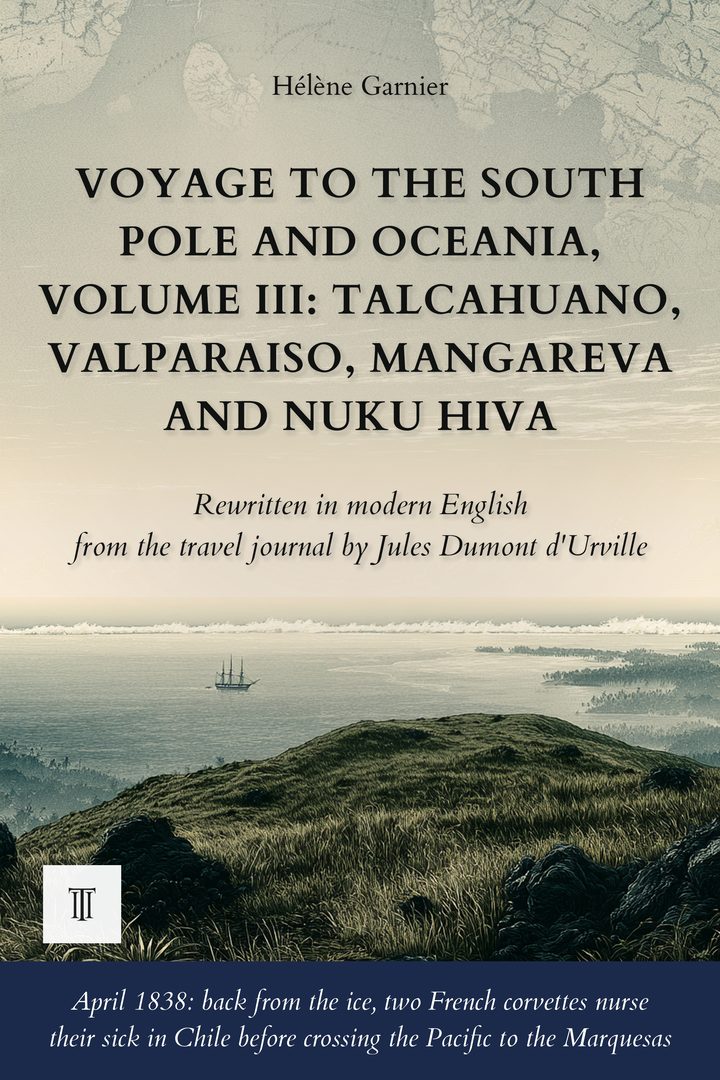
Voyage to the South Pole and Oceania, Volume III: Talcahuano, Valparaiso, Mangareva and Nuku Hiva
Modernized, illustrated English edition of Voyage au pôle Sud et dans l'Océanie by Jules Dumont d'Urville (1837-1840).
April 1838: back from the ice, two French corvettes nurse their sick in Chile before crossing the Pacific to the Marquesas
Read more ↓- about 280 pages
- Paperback
- English
- 19th century
Countries covered: Chile · French Polynesia
About this book
8 April 1838, in the morning: in the bay of Talcahuano, the crews of the Astrolabe and the Zélée climb on deck to see land again, and the scurvy patients regain their colour at the mere sight of it.
Jules Dumont d'Urville brings back from the far South corvettes with eaten-away copper sheathing, and forty sick men aboard Captain Jacquinot's Zélée. Six weeks' stay in Chile follow: a hospital ashore, the Astrolabe twice run aground near the watering place to repair her stem, whalers from Le Havre and their deserters, a whale's brain for the phrenologist, Concepción still in ruins after the earthquake of 1835, and the cacique Penoleo, Benavides' companion in arms, now an inglorious pensioner. At Valparaiso, in the mail, a little note from his wife awaits him, which he opens in dread.
Then sixty-four days of a thwarted crossing: Robinson's island, a sailor who could not swim, Easter Island, which has to be given up. At the Gambier Islands, the Bishop of Nilopolis, Father Cyprien and King Mapu-teoa in a blue frock coat receive the French, and a mass is celebrated amid a musket salute; what is learned there about Tahiti secretly decides the route. Then come the Tuamotus and their unfindable islands, and finally, in the Marquesas, a polyglot islander who plays Scapin.
The journal of a commander struck to the heart who chooses to press on, and who looks at the Pacific with the eye of the sailor, the scholar and the judge.
Product details
- Publisher
- Itinerarium Éditions
- Series
- South Pole
- The author
- Jules Dumont d'Urville
- Date of the journey
- 1838
- Modern edition by
- Hélène Garnier
- Language
- English
- Format
- Paperback, 6 × 9 in (15.2 × 22.9 cm)
- Pages
- about 280
The author
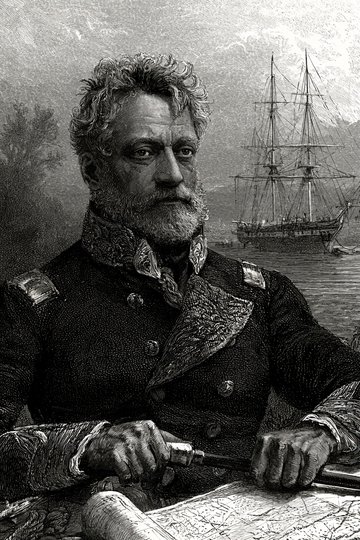
Jules Dumont d'Urville
Jules Dumont d'Urville was born on 23 May 1790 at Condé-sur-Noireau, in Normandy, into a family of minor nobility, and joined the navy in 1807. Second-in-command to Duperrey on the Coquille (1822-1825), then commander of the Astrolabe (1826-1829), he found at Vanikoro the traces of La Pérouse's expedition. His third campaign, which left Toulon in 1837 with the Zélée under Captain Jacquinot, took him from the southern ice to Adélie Land, then across Oceania; from it he drew the Voyage au pôle Sud et dans l'Océanie, published in Paris by Gide from 1841. Promoted rear admiral in 1840, he is also known for having proposed the terms Polynesia, Micronesia and Melanesia. He died on 8 May 1842 in the Meudon railway disaster, together with his wife and his son.
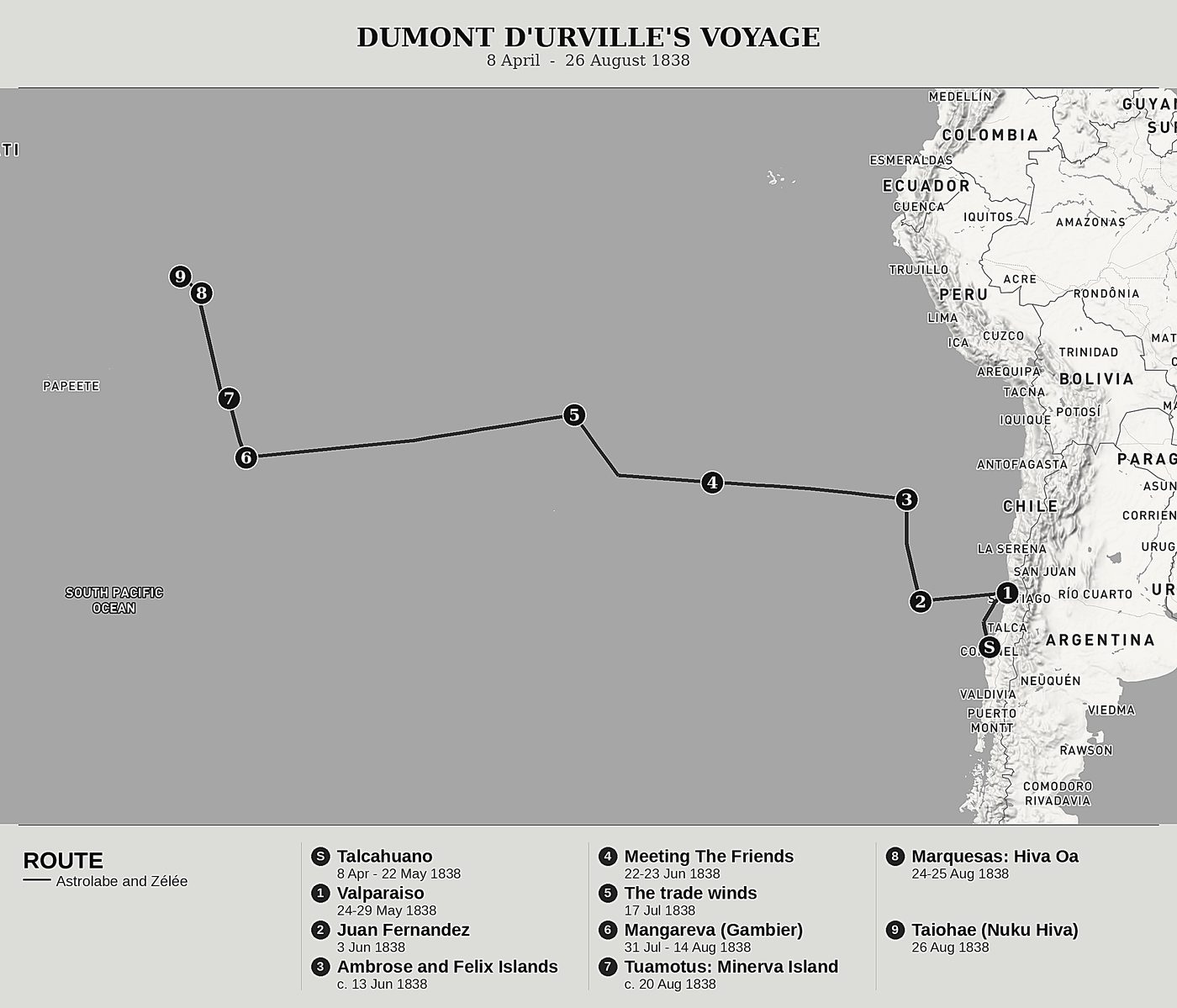
All books by Jules Dumont d'Urville →The journey mapped
In the Same Place, Through the Centuries
-
Herman Melville, Typee: A Peep at Polynesian Life (1842)
In July 1842, four years after the Astrolabe, the American whaler Acushnet anchors in the bay of Taiohae, a few weeks after Admiral Dupetit-Thouars took possession of Nuku Hiva in the name of Louis-Philippe.
Read a free edition → -
Max Radiguet, Les Derniers Sauvages : souvenirs de l'occupation française aux îles Marquises, 1842-1859 (1842)
Aboard the Reine-Blanche, Admiral Dupetit-Thouars' frigate, Max Radiguet witnesses in 1842 the taking of the Marquesas: Tahuata on 1 May, Nuku Hiva in early June.
-
Edmond Reuel Smith, The Araucanians, or Notes of a Tour among the Indian Tribes of Southern Chili (1853)
On 4 January 1853, Edmond Reuel Smith leaves Concepción for the Biobío frontier.
Read a free edition → -
Robert Louis Stevenson, In the South Seas (1888-1889)
On 28 July 1888, before dawn, the yacht Casco approaches Nuku Hiva and enters the bay of Anaho: Robert Louis Stevenson, ill in the lungs, discovers the South Seas.
Read a free edition →
The modern editor

More in this series
See all →