 South Pole · Modernised and illustrated edition
Journal of a Voyage to the Coast of Patagonia
Modernized, illustrated English edition of Diario de un viaje a la costa de Patagonia by Antonio de Viedma (1780-1783).
A Jesuit skirts the wild Patagonian coast, between missions and uncharted lands.
Read more ↓- 210 pages
- Paperback
- English
- 18th century
Countries covered: Argentina
About this book
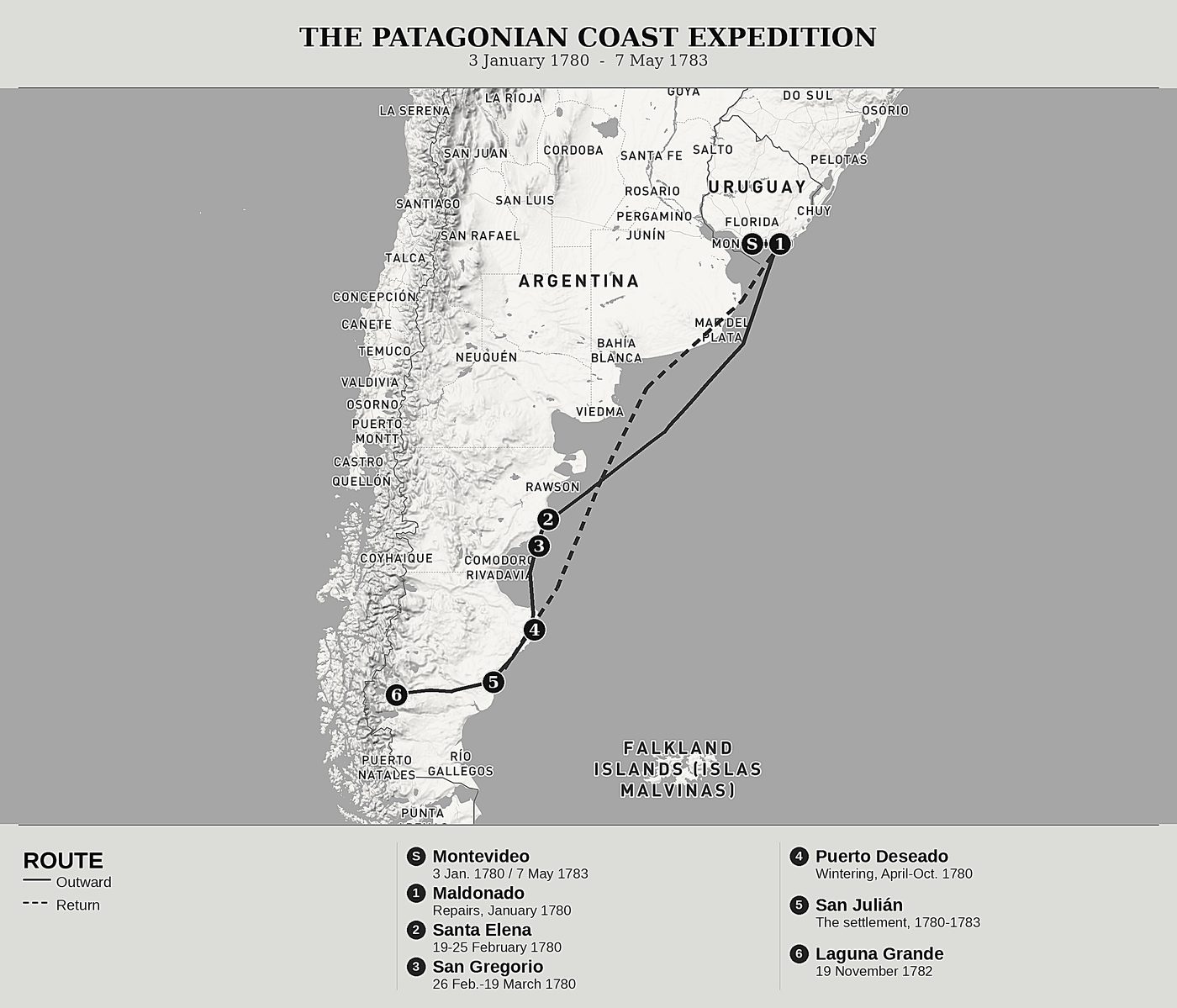
January 1780. Three vessels of the King of Spain leave Montevideo for a coast that no one has ever surveyed. Their mission can be put in a single sentence: to find, somewhere between the 44th and the 52nd degree of south latitude, a harbour, fresh water and good land, and to found a town there. Antonio de Viedma, an official of the Crown, keeps the journal of this obstinacy.
Four harbours sounded without finding a spring. Wells dug and then deepened because the water comes up brackish. The frigate Nuestra Señora del Carmen runs aground and breaks up in the night with the horses still on board. A winter of scurvy, eighteen days of frost, a comet, mutiny placards nailed up at night under a hut at Puerto Deseado. Viedma sends the sick and the discontented back to Buenos Aires and stays on this coast with fifteen men. At the Pozos de San Julián he raises a wooden fort, blesses a chapel, sows wheat that finally comes up, and waits two summers for a ship that does not arrive.
Then there are the others. Two hundred horsemen on the beach, a cacique named Julián who lends his horses and refuses sabres, a cauldron of flour shared every morning, a quarrel over access to the salt flat, a funeral at which the dead woman's horses are sacrificed. Three years of neighbourly life with the Tehuelche, and at the end the November 1782 march to the west, as far as the great lagoon from which the Río de Santa Cruz flows, at the foot of two snow-covered peaks that the Indians call the chaltel. No map in Europe shows them yet.
The journal is followed by a description written in Buenos Aires in December 1783: the coast surveyed harbour by harbour from the 44th to the 52nd degree, then the portrait of a people observed at close quarters for three years, their toldos, their hereditary cacicazgo, their marriages, their quarrels settled with fists, their idol Camalasque carved from the wood of shipwrecks. Few eighteenth-century witnesses looked at the Tehuelche so closely or for so long. Published only in 1837 by Pedro de Angelis in Buenos Aires, after fifty-four years in the archives of Seville, this text had never been translated into French and, as far as we know, not into English, Portuguese or Italian either: it existed only in Spanish, in a scholarly edition shared with another narrative.
The first complete modern rewriting for today's reader, making this testimony accessible without betraying anything of the voyage. Original illustrations and ten maps of the voyage show the route, while a set of reference aids (glossary, chronology, index) and selected passages of the original text shed light on the reading.
Product details
- Publisher
- Itinerarium Éditions
- Series
- South Pole
- The author
- Antonio de Viedma
- Date of the journey
- 1780-1783
- Modern edition by
- Hélène Garnier
- Language
- English
- Format
- Paperback, 6 × 9 in (15.2 × 22.9 cm)
- Pages
- 210
- ISBN
- 978-2-489331-06-6
The author
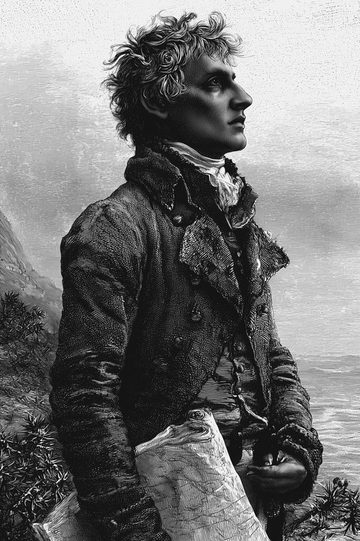
Antonio de Viedma
Antonio de Viedma (1742-1791) belongs to that generation of Spanish officials whom the Crown sent, in the last decades of the eighteenth century, to occupy the Atlantic seaboard left empty between Buenos Aires and the Strait of Magellan. He reached the Río de la Plata in 1778 and had not come to command: the charge of San Julián Bay belonged to his elder brother Andrés, whose reason gave way on the spot. A man of registers rather than a discoverer, he kept from January 1780 to the spring of 1783 the journal of the settlement he founded and defended, and in Buenos Aires, in December 1783, he signed the description of the Patagonian coast and the Tehuelche that closes the volume.
All books by Antonio de Viedma →The journey mapped
In the Same Place, Through the Centuries
-
John Byron, relation du voyage du Dolphin (1773)
Twelve years before Viedma, the English admiral enters San Julián Bay and swears he saw men nine feet tall.
-
Thomas Falkner, A Description of Patagonia (1774)
An English physician turned Jesuit spends forty years in the missions of the Río de la Plata and comes home with the first reasoned description of the Patagonian interior, its peoples and its rivers.
-
George Chaworth Musters, At Home with the Patagonians (1871)
An English naval officer crosses Patagonia from the Strait of Magellan to the Río Negro, living for eighteen months with the Tehuelche, on horseback, in their toldos, at the rhythm of their hunts.
-
Lady Florence Dixie, Across Patagonia (1880)
A Scottish aristocrat sets out to hunt in the south with her brother, her dogs and a cook, and brings back the first Patagonian narrative written by a woman.
The modern editor

More in this series
See all →