 South Pole · Modernised and illustrated edition
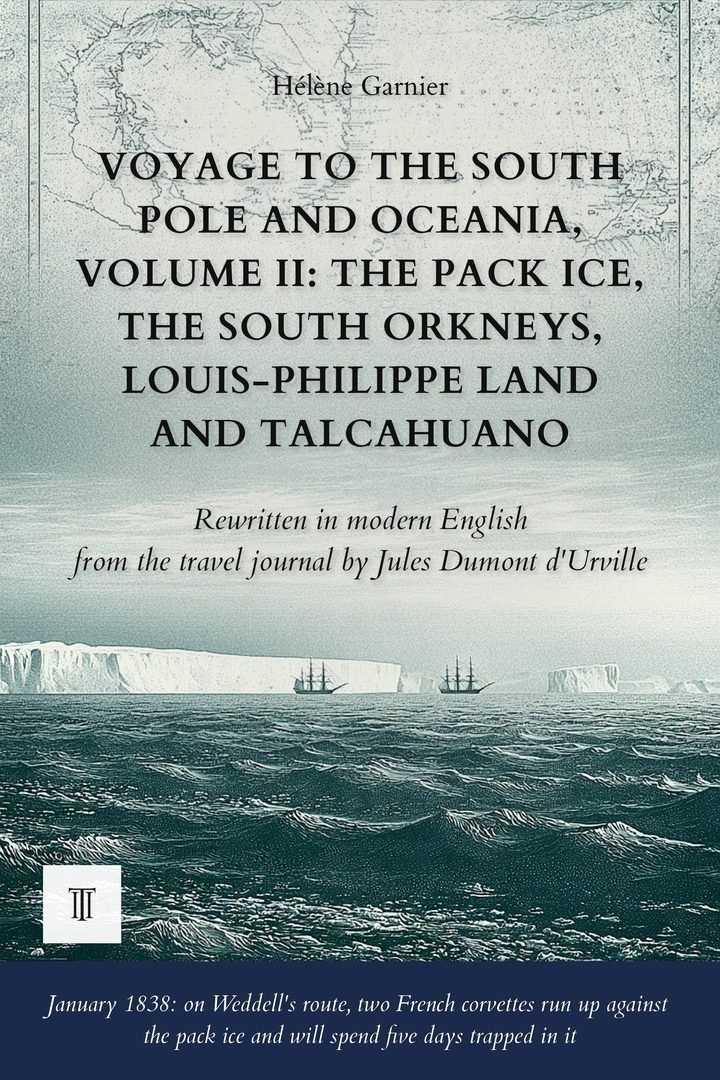
Voyage to the South Pole and Oceania, Volume II: The Pack Ice, the South Orkneys, Louis-Philippe Land and Talcahuano
Modernized, illustrated English edition of Voyage au pôle Sud et dans l'Océanie by Jules Dumont d'Urville (1837-1840).
January 1838: on Weddell's route, two French corvettes run up against the pack ice and will spend five days trapped in it
Read more ↓- about 240 pages
- Paperback
- English
- 19th century
Countries covered: Antarctica · Argentina · Chile
About this book
22 January 1838, a quarter to four in the morning: the Astrolabe's lookout cries that the way is barred, and Jules Dumont d'Urville, hurrying up on deck, sees the pack ice for the first time.
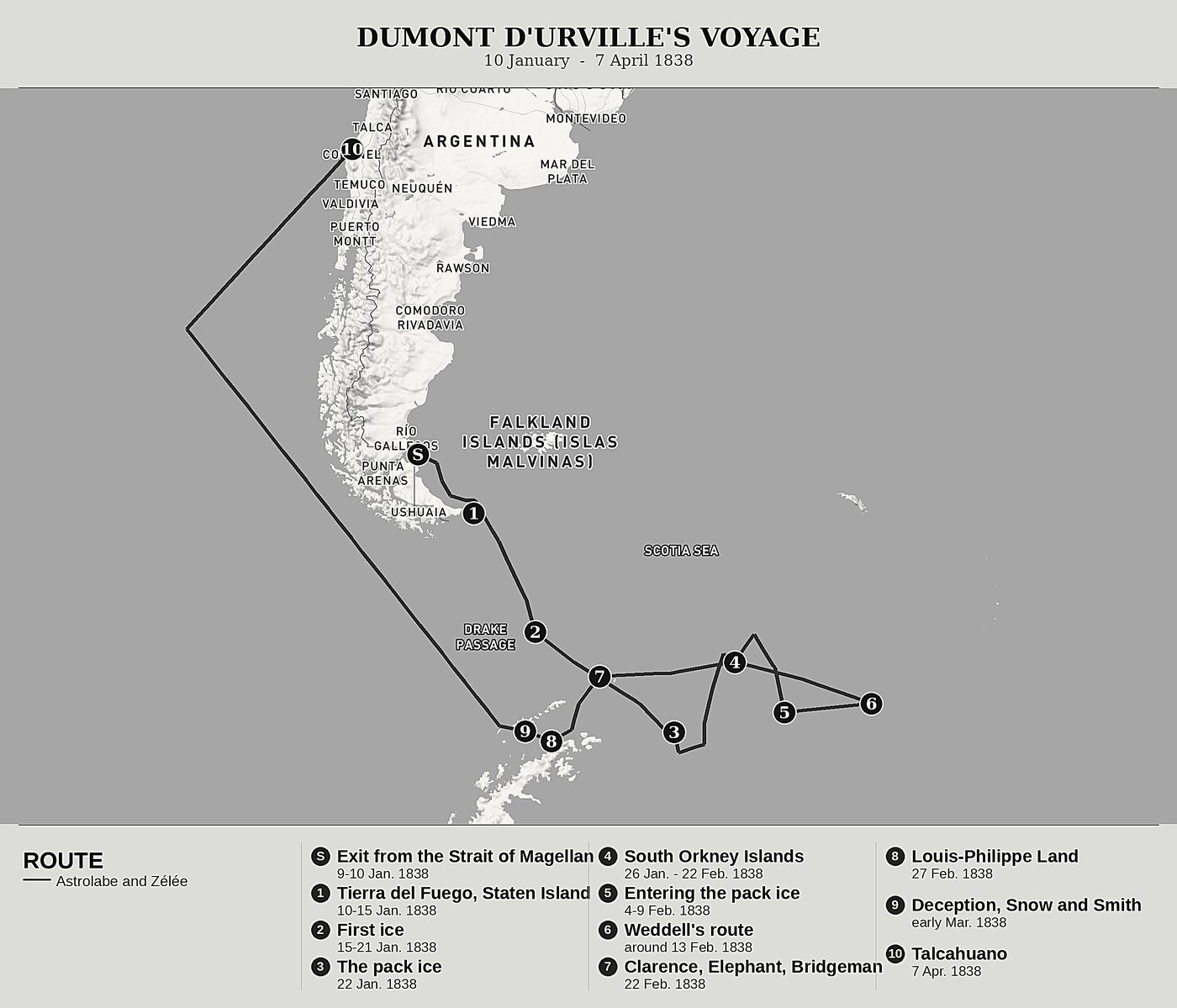
Out of the Strait of Magellan, the commander has headed south with Captain Jacquinot's Zélée, on the route where the sealer Weddell had found open sea in 1823. Before the ice, he reviews those who went before him, from Cook to Bellingshausen and the seal hunters. Then come the first islands of ice, celebrated with a double ration, a false land that vanishes within an hour, a night hove to between three floes, a city of marble at sunrise, the New South Orkney Islands drowned in fog.
On 4 February, yielding to the general wish, he resolves to try his fortune to the end and sends his corvettes into the pack ice. Wakings under the shocks, sailors making their way on foot across the ice, seal on the menu, a chief caulker who is nearly left behind by the ship: five days as prisoners. Once free, he still has to test Weddell's route, to name an unknown land risen out of the snow, and to bring home crews threatened by scurvy.
The journal of a precise commander, clear-sighted about his own imprudence, which asks how far a leader may take his men toward the pole.
Product details
- Publisher
- Itinerarium Éditions
- Series
- South Pole
- The author
- Jules Dumont d'Urville
- Date of the journey
- 1838
- Modern edition by
- Hélène Garnier
- Language
- English
- Format
- Paperback, 6 × 9 in (15.2 × 22.9 cm)
- Pages
- about 240
The author
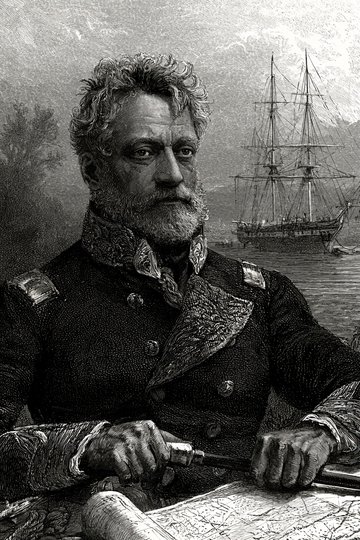
Jules Dumont d'Urville
Jules Dumont d'Urville was born on 23 May 1790 in Condé-sur-Noireau, in Normandy, into a family of minor nobility, and joined the navy in 1807 as a midshipman. A naval lieutenant, he took part in the circumnavigation of the Coquille (1822-1825), then commanded the Astrolabe from 1826 to 1829, before leading, from 1837 to 1840, the expedition of the corvettes Astrolabe and Zélée toward the southern ice and Oceania. The narrative, published in Paris by Gide from 1841 under the title Voyage au pôle Sud et dans l'Océanie sur les corvettes l'Astrolabe et la Zélée, reports in particular the taking of possession of Adélie Land in 1840. His name remains associated with the division of Oceania into Polynesia, Micronesia and Melanesia. A rear admiral since December 1840, he died on 8 May 1842 in the Meudon railway disaster.
All books by Jules Dumont d'Urville →The journey mapped
In the Same Place, Through the Centuries
-
James Clark Ross, A Voyage of Discovery and Research in the Southern and Antarctic Regions, during the Years 1839-43 (1842-1843)
Five years after the French corvettes, James Clark Ross set out from the Falklands with the Erebus and the Terror and, at the end of 1842, came before the lands that Dumont d'Urville had named: Louis-Philippe Land and Joinville…
Our edition → -
Otto Nordenskjöld et Johan Gunnar Andersson, Antarctica, or Two Years amongst the Ice of the South Pole (1901-1903)
Sixty years after Dumont d'Urville, the waters around Louis-Philippe Land became the setting of a polar Robinsonade.
-
Robert Neal Rudmose Brown, Robert Cockburn Mossman et James Hunter Harvey Pirie, The Voyage of the Scotia (1902-1904)
On 25 March 1903, the Scotia of William Speirs Bruce's Scottish expedition dropped anchor in a bay of Laurie Island, in the South Orkneys, which the French corvettes had skirted in February 1838.
-
Jean-Baptiste Charcot, Le Pourquoi-Pas ? dans l'Antarctique (1908-1910)
In August 1908, Jean-Baptiste Charcot left Le Havre on the Pourquoi-Pas?, a polar three-master built for him at Saint-Malo, and reached Antarctica in December.
The modern editor

More in this series
See all →