Biography
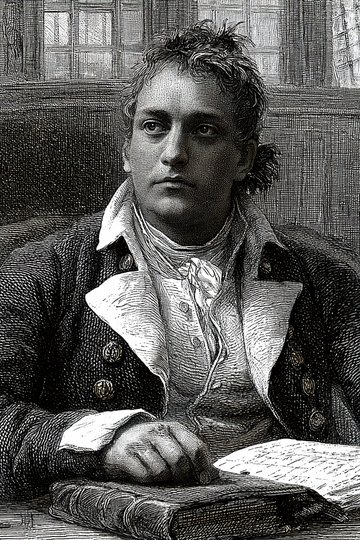
William Bligh was born on 9 September 1754. The place remains uncertain: Plymouth is the most likely, since he was baptised there on 4 October 1754 at St Andrew's church and his father, Francis, worked there in the customs; Tinten Manor, at St Tudy in Cornwall, is sometimes mentioned. According to the Australian Dictionary of Biography, he was entered on a ship's books as early as 1762, then actually joined the navy on 27 July 1770 and became a midshipman in February 1771.
In 1776 James Cook chose him as master (navigating officer) of the Resolution for his third voyage. Bligh drew many charts and plans of bays and anchorages, and helped bring the expedition back to England in 1780, after Cook's death. He married Elizabeth Betham on 4 February 1781, at Onchan, on the Isle of Man; the couple had six surviving daughters. Supported by Joseph Banks, he received command of the Bounty, which sailed in November 1787 to fetch breadfruit from Tahiti. On 29 April 1789 the crew mutinied and set him adrift in a launch with eighteen loyalists; he reached Timor about six weeks later. A court martial honourably acquitted him in October 1790.
The book in this collection is the fruit of the second attempt. Commanding the Providence, escorted by Nathaniel Portlock's Assistant, he left England in 1791 and returned in September 1793. His journal, whose original title is Log of the Proceedings of His Majesty's Ship Providence on a Second Voyage to the South Sea, keeps account of the winds, the soundings and the health of the men. The plants were carried to the West Indies, but most of the slaves refused to eat them, and the economic aim was not achieved. The Royal Society of Arts awarded him a gold medal.
Bligh pursued his career with distinction. Captain of the Director, he was at Camperdown on 11 October 1797 and received the naval gold medal. In the Glatton, he fought at Copenhagen on 2 April 1801 under Nelson. On Banks's recommendation, he was appointed governor of New South Wales in 1805 and arrived there on 6 August 1806. His struggle against the rum trade and the dealings of the New South Wales Corps earned him many enemies: on 26 January 1808, soldiers led by Major George Johnston arrested him. He was held until January 1810 and returned to England in October 1810.
Rear-admiral in 1810, vice-admiral in June 1814, he gave evidence in 1812 before the parliamentary committee on transportation. A widower since April 1812, he died of cancer on 7 December 1817 in Bond Street, London, and rests at St Mary's, Lambeth, today the Garden Museum. His grandson William Russell Bligh handed the family papers to the Public Library of New South Wales in 1902; they are now in the Mitchell Library in Sydney, with a series devoted to the Providence.