Biography
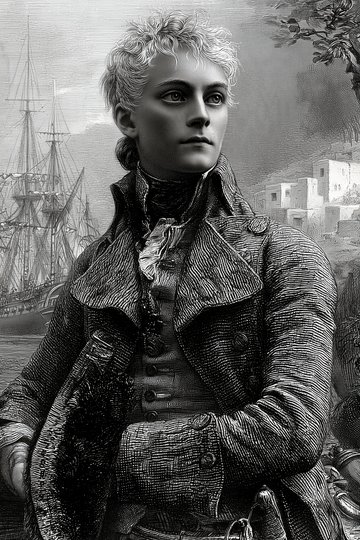
Sergei Ivanovich Pleshcheev was born in 1752 into an old family of the Russian nobility, the Meshkov-Pleshcheev branch. His father, Ivan Vasilievich, held the rank of premier-major; his mother, Maria Kirillovna, was born a Chicherin. Like many sons of the gentry, he was enrolled in the Guards as a child, as a soldier from 1759 and then as a non-commissioned officer in the Izmailovsky Regiment.
In November 1764 he became a midshipman and left for England to learn the sea. For five years in a row, from 1765 to 1770, he sailed on British ships along the coasts of North America. There he earned his lieutenant's commission in 1769, perfect English and, according to the Russian Biographical Dictionary, a Russian so uncertain that he would sometimes write first in English and then translate himself.
In 1770 he joined the squadron Russia sent to the Mediterranean against the Ottoman Empire and cruised in the Greek Archipelago aboard the St George the Victorious. In 1772 Count Alexei Orlov sent him to the coasts of Syria and Palestine, to Ali Bey, the Mamluk in revolt against the Sultan. The journal of that mission appeared in St Petersburg in 1773; it was later translated into German.
Back in Russia in 1773, he was promoted captain-lieutenant the following year. In 1775, attached to Prince Repnin's embassy in Constantinople, he surveyed the Dardanelles, and in 1776 the approaches to Sinope and Trebizond. In 1781 he entered the service of Grand Duke Paul, heir to the throne and grand admiral, and became one of his intimates; he taught geography to Grand Duchess Maria Feodorovna. He went on to command the ships Chesma and Asia, rising to the rank of major-general of the fleet in 1789.
A curious mind and a linguist, he published the account of the Grand Dukes' journey through Europe and above all a Survey of the Russian Empire in its present state, issued from 1786, reprinted until 1793 and translated into several languages, including English in 1792: one of the first geographical descriptions of Russia region by region. A Freemason, he frequented the Martinists' Friendly Learned Society in Moscow from 1781, which earned him the distrust of Catherine II.
On the accession of Paul I in 1796 he received two thousand serfs and the title of adjutant general, then in 1797 the rank of vice-admiral. The favour was short-lived: pushed out of court in 1798 by intrigue, he withdrew to Moscow. He died in Montpellier on 23 January 1802, by the Julian calendar, leaving all his property to his wife, Natalia Fedotovna, born Verigina, whom he had married in 1796.