Biography
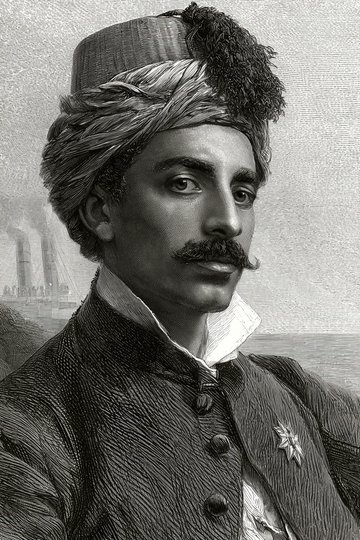
Muhammad Ali Tewfik was born in Cairo on 9 November 1875. He was the son of Khedive Tewfik and Emina Ilhamy, and the younger brother of Abbas II Hilmi, who succeeded their father. According to the Arabic encyclopedia Marefa, from 1881 to 1883 he attended the Abdine school reserved for princes, then was sent to Switzerland to study military science in Geneva. He also spent time at the Theresianum in Vienna, to which he would devote a volume of memoirs much later. His father's death in 1892 brought him back to Egypt.
From 1892 to 1899 he was his brother's heir presumptive. From 1901 he had the Manial Palace built on Roda Island in Cairo, whose plans and decoration, according to Marefa, he designed himself, and which he filled with works of art, mostly Islamic, bought or received as gifts. The museum that now occupies the palace presents him as a pious man, a fine horseman and a great breeder of purebred Arabian horses, a subject to which he devoted a work in 1936.
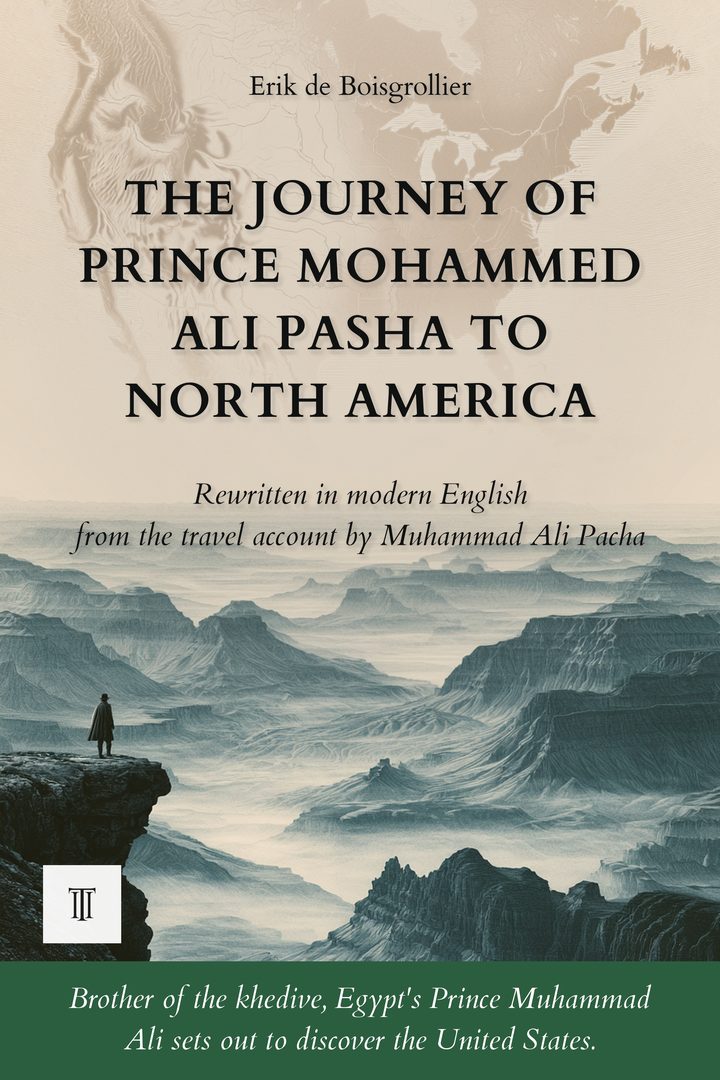
Travel was the great business of his life. He published in Arabic accounts of his summer in Bosnia-Herzegovina (1906), his journey to Japan (1909) and his tour of the Levant (1911). In the spring of 1912, with two companions and a programme arranged by the Cook agency, he left Cherbourg for three months across the United States, Alaska and Canada. The account appeared in Cairo in 1913, from the National Press (al-Matba'a al-Amiriyya), under the title Rihlat sumuww al-Amir Muhammad Ali Basha ila al-jiha al-shamaliyya li-Amrika, in more than four hundred pages.
When the British deposed Abbas II in 1914, the prince in turn was kept away from Egypt, according to Marefa, and settled in Montreux. He went on travelling and writing: a travel diary of South Africa, in French (1923), then an account of his stay in Java (1926). On the death of King Fuad in 1936, he sat on the regency council that governed for the young Farouk until he came of age in 1937. Heir presumptive once again, he saw that prospect vanish in January 1952 with the birth of Farouk's son, Ahmed Fuad.
The proclamation of the republic in 1953 left him in exile. In his last years he published in French his memoirs of youth, on the Theresianum (1948) and then on Paris (1950). He died in Lausanne on 18 March 1955 and is buried in Cairo, in the family mausoleum of Hosh al-Basha. His Manial Palace has become a museum open to the public, and the original edition of his American journey has been digitised in Arabic Collections Online, from a copy held by the American University in Cairo.