Biography
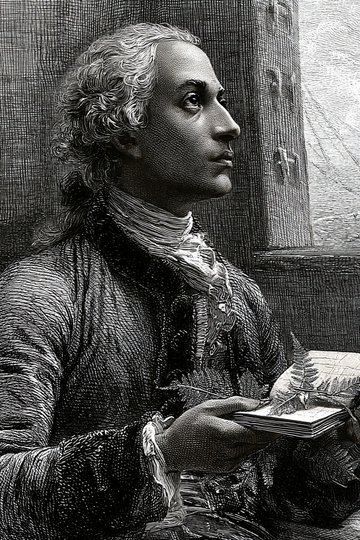
Jacques-Henri Bernardin de Saint-Pierre was born in Le Havre on 19 January 1737, into a Norman family. As a child he read Robinson Crusoe and, at about twelve, sailed with a captain uncle to the West Indies, an experience that left him disappointed with the sea. He studied science at Caen and then Rouen, before training as an engineer at the school of the Ponts et Chaussées and entering the King's service.
His career as a military engineer was bumpy. During the Seven Years' War he was dismissed from a post for insubordination; he then went to Malta, then to the Netherlands and Russia, where he vainly hoped to find a passage to the Indies. A stay in Poland ended in a romantic affair; he passed through Dresden and Berlin before returning to France, in 1766 or 1765 depending on the sources.
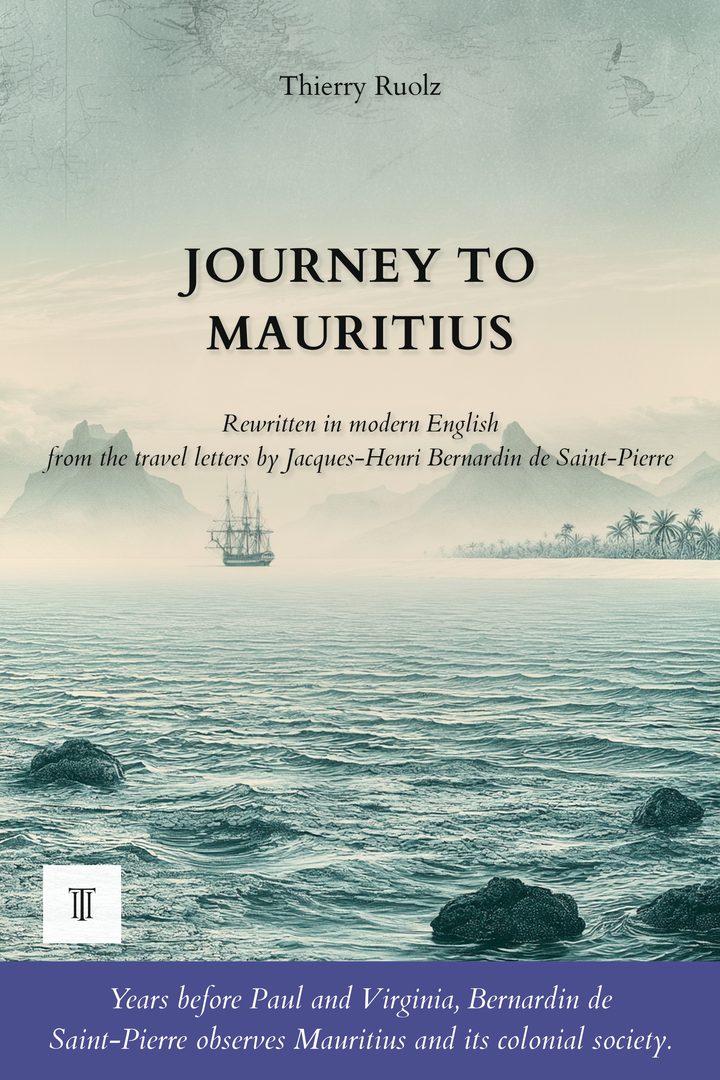
In 1768, without fortune, he obtained a post as captain-engineer on the Isle de France, present-day Mauritius, where he stayed about three years. There he observed nature and colonial society, spoke out against deforestation and against slavery, and returned by way of Bourbon, the Cape and Ascension. His letters make up the Voyage à l'isle de France, à l'isle de Bourbon, au cap de Bonne-Espérance, avec des observations nouvelles sur la nature et sur les hommes, par un officier du Roi, published in two volumes, anonymously, in 1773, at Amsterdam, with sale in Paris at Merlin's. The book established his reputation, and a pension of about a thousand livres was granted to him according to the English-language Wikipedia entry.
In Paris, d'Alembert introduced him into the salon of Julie de Lespinasse, where he nonetheless felt apart from the Encyclopedists. Above all he befriended Jean-Jacques Rousseau, with whom he went botanizing and whose love of nature he shared. The Studies of Nature (1784) made him famous; Paul and Virginia, dated 1788 or 1789 depending on the sources, first appeared in it as a supplement. Among the works that followed were La Chaumière indienne (1790), the Harmonies of Nature (1796), De la nature de la morale (1798) and the Voyage en Silésie (1807). His play Empsaël et Zoraïde, written in 1775, would not be published until 1904.
Appointed intendant of the Jardin du Roi in 1792, he saw the institution become the Muséum national d'histoire naturelle, which abolished his post. He taught morals at the École normale of Year III in 1794, entered the Institut in 1795 and the Académie française in 1803. Married in 1792 to Félicité Didot, then in 1800 to Désirée de Pelleport, he died at Éragny, on the Oise, on 21 January 1814. Louis-Aimé Martin brought out his complete works from 1813. The sources consulted do not say where his papers are kept.