Biography
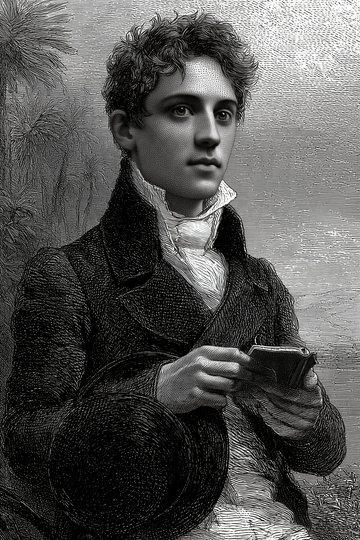
George Waddington was born on 7 September 1793 at Tuxford, Nottinghamshire, where his father was vicar. Through his mother, Anne Dollond, he descended from the optician Peter Dollond, whose family made spectacles and instruments in London. A pupil at Charterhouse from 1808 to 1811, he entered Trinity College, Cambridge, in 1812, where he won prizes for Latin and English verse, including the Chancellor's Medal in 1813. He graduated in 1815, became a minor fellow of his college in 1817 and a full fellow the following year.
At Trinity he became friends with Barnard Hanbury, born the same year and a fellow of the same college. Early in 1820 the two friends met in Venice and set off for Egypt as antiquaries. There they learned that Muhammad Ali was sending his son Ismail Pasha to conquer Nubia and the Sudan, and they decided to follow the army beyond the Second Cataract. From Wadi Halfa to Jebel Barkal they crossed a country at war, measured temples and pyramids and identified the site of Napata, until an order from the Pasha sent them back north. Their account appeared in 1822 as Journal of a Visit to Some Parts of Ethiopia; according to the English biographical notices, Waddington wrote the text and made its seventeen drawings. The two travellers also brought back to Cambridge a set of Egyptian coffins, the first Egyptian object to come into the university's possession, now in the Fitzwilliam Museum.
Barnard Hanbury, who had taken holy orders, died in 1833.
Waddington travelled again: in 1823 and 1824 he visited Greece in the middle of its War of Independence and drew from it A Visit to Greece (1825), followed by an essay on the Greek Church (1829). Ordained around 1826, he turned to religious history, with a history of the Church from its origins to the Reformation (1833) and a history of the Reformation on the Continent (1841). He was vicar of Masham, in Yorkshire, from 1834, and held a prebend at Chichester. In 1840 he was appointed Dean of Durham, an office he held for almost thirty years; from 1862 he was also Warden of the young University of Durham. He died in Durham on 20 July 1869.
The 1822 Journal preserves the view of two European eyewitnesses of the Egyptian conquest of the Sudan, at the very moment it was taking place.