Biography
Georg Johann Unverzagt was born in 1701 and died in 1767, dates given by the Deutsche Digitale Bibliothek on the basis of the German authority record. A biographical note from RusArtNet specifies Copenhagen for his birth and Saint Petersburg for his death, but it cites no source and I have found no second confirmation: these two places should therefore be treated with caution. Of his family and his education, nothing reliable could be established, and it is better to say so than to fill the gap.
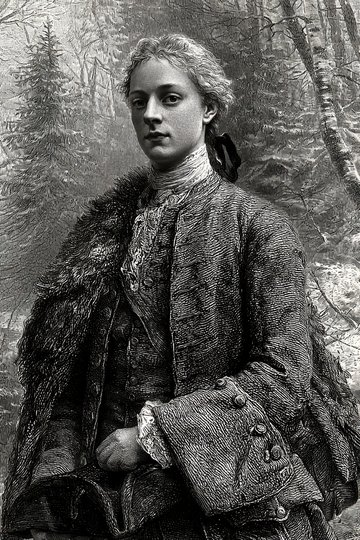
The same RusArtNet note presents him as an engraver and draughtsman. It states that he taught engraving from 1726 in the engraving workshop of the Imperial Academy of Sciences in Saint Petersburg and that he engraved a plan of the city in 1741. This artistic career is attested only by that page; it fits the image of a young man skilled with his hands and attentive to landscapes, costumes and ceremonies, as he appears in his account, though the sources do not allow us to affirm it.
His name remains attached to a single journey. In July 1719, Peter the Great sends the guards captain Lev Izmailov to Peking to establish commercial relations with the Emperor Kangxi. Unverzagt, eighteen at the outset if 1701 is accepted, belongs to the retinue. He keeps the journal of a sixteen-month road by way of the Volga, the Urals, Tobolsk, Lake Baikal and Mongolia, then of the four months spent at court. Lorenz Lange, a lieutenant of Swedish origin in the tsar's service, remains in Peking as commercial agent until 1722; Unverzagt stays with him, then brings back the tapestries given by Kangxi, which the tsar examines at Murom in 1722.
The account appears in German under the title Die Gesandschafft Ihro Käyserl. Majest. von Gross-Rußland an den Sinesischen Käyser, at Lübeck, from the press of Schmidt. Wikipedia (article on Lorenz Lange) and RusArtNet give the year 1725. The catalogue record of the University of Wisconsin library describes an edition of 1727, printed at Lübeck and Ratzeburg, announced as closely revised ("aufs neue übersehen"), of 151 pages with nine folding plates. There may thus be two states or two editions; I was unable to decide. The book closes with a description of Chinese customs: weddings, funerals, theatres, towns, Peking and the Great Wall.
I have found no other writing by Unverzagt, nor any indication of his correspondents or convictions. As for his papers, no source consulted says where they are. The author's posterity is that of his book: the Deutsche Digitale Bibliothek lists two digitised documents linked to him, both devoted to the embassy of 1719, and the account is cited among the testimonies on Izmailov's mission and on Lange's stay in Peking.