Biography
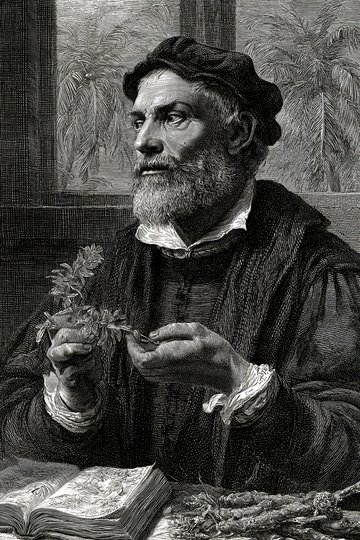
Garcia de Orta was born around 1501 in Castelo de Vide, in the Alentejo; the exact year remains uncertain. His parents, Fernão (Isaac) de Orta, a merchant, and Leonor Gomes, were Jews of Spanish origin who had taken refuge in Portugal after 1492 and were forcibly converted in 1497. He studied the arts, natural philosophy and medicine at Salamanca and Alcalá de Henares, and returned to Portugal around 1523-1525, shortly after his father's death, according to the sources.
He first practised in Castelo de Vide, then settled in Lisbon in 1526. There he became physician to King John III and kept company with the mathematician Pedro Nunes; he also taught natural philosophy at the University of Lisbon in the early 1530s. In March 1534 he embarked as physician to Martim Afonso de Sousa, captain-major of the Indian seas, whose fleet left the Tagus on 12 March. He accompanied him on his campaigns along the west coast of India, then settled in Goa in 1538, never to return to Europe.
In Goa his clientele grew: he treated Portuguese viceroys and the sultan of Ahmadnagar, Burhan Nizam Shah. He married his cousin Brianda de Solis (in 1541 or 1543, depending on the source) and the couple had two daughters. He also traded in drugs and stones. Around 1554-1555, Viceroy Pedro Mascarenhas granted him a lease of the island of Bombay, where he owned a house. He himself travelled little beyond the west coast: what he knew of Ceylon, Malacca or the Moluccas came from merchants and witnesses whom he questioned.
These years fed his only book, Colóquios dos simples e drogas he cousas medicinais da Índia, printed in Goa in 1563. In it Orta stages a dialogue with a fictional colleague, Dr. Ruano, and reviews the drugs of the East in alphabetical order. He sets against Dioscorides, Galen and Avicenna what he has seen and verified, and describes cholera, among other things, from an autopsy. The volume also contains a poem by Camões, a friend. Written in Portuguese, it circulated little; it became known in Europe thanks to the Latin abridgement that Charles de l'Écluse (Clusius) published in 1567, while Cristóvão da Costa gave a Castilian version in 1578.
Orta died in Goa in 1568, never having been troubled in his lifetime. Yet the Inquisition had been established in Goa in 1565: his sister Catarina was burned in 1569, and he himself, tried posthumously for Judaism, had his remains exhumed and burned at the auto-da-fé of 1580. His book outlived him. It was reissued in Lisbon in 1872, then in the reference edition of the Count of Ficalho (1891-1895), and translated into English by Clements Markham in 1913. A garden in Lisbon bears his name today.