Biography
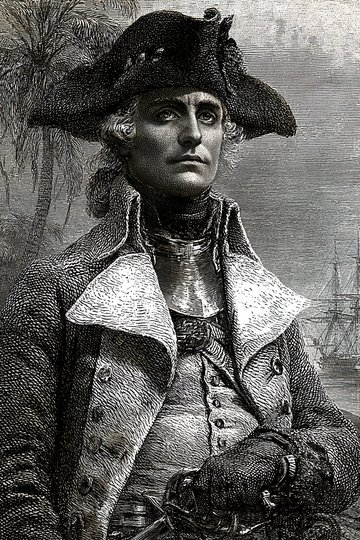
Very little is known about the origins of Pierre-Antoine Duprat. The authority record of the Bibliothèque nationale de France gives neither the year nor the place of his birth, and merely states that he lived between the eighteenth and nineteenth centuries. The title of count, under which he signs his book, is the only clue to his rank; the sources consulted say nothing about his family or his education.
When he enters history, he is a colonel of infantry. According to his own account, at the end of 1772 he receives a colonel's commission and the orders to command at Mahé, a small French trading post on the Malabar Coast. He sails from Lorient, reaches Pondicherry on 28 March 1773, stays there two months, then arrives at Mahé on 19 November 1773. The historians of French India S. P. Sen and K. V. Krishna Iyer, cited by the Historic Alleys website, specify that he succeeds Picot de La Motte there, who was then on leave.
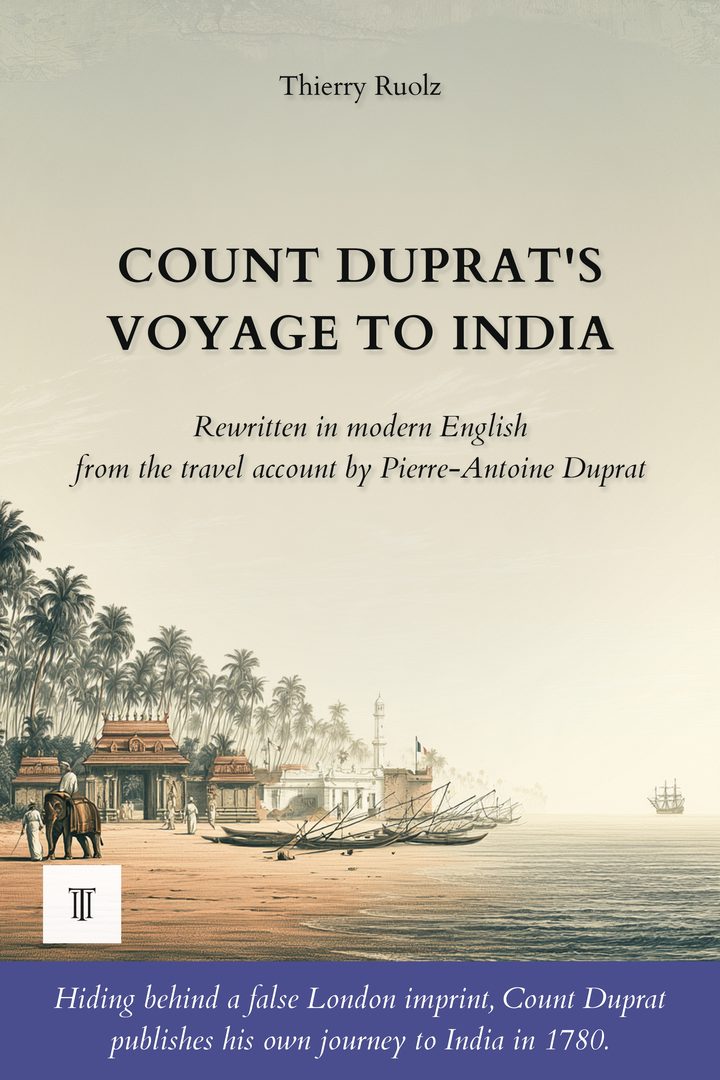
Malabar is at that moment invaded by the army of Hyder Ali, Nawab of Mysore. The Zamorin of Calicut, under threat, is looking for a protector, and Duprat seizes the opportunity without waiting for Pondicherry's consent. In January 1774, a treaty places Calicut under the protection of the King of France; Duprat lands from the frigate Belle Poule with a small force and a few cannon, and receives the keys of the kingdom. The arrival of the Nawab's general and the flight of the Zamorin ruin the enterprise. Back at Mahé, Duprat imposes a pepper monopoly on the King of Cartenatte and fortifies the colony. According to the same historians, he is reprimanded in writing as early as February 1774, then recalled by Jacques Law de Lauriston, governor general at Pondicherry, who has him replaced at Mahé. He himself states that he handed over his command on 4 May 1774. His plea appears in 1780 under the title Voyage du comte Duprat dans l'Inde, écrit par lui-même, with the imprint "A Londres", probably false, in a single octavo volume of 133 pages.
Above all, the book reveals a man convinced of French power and of the value of daring: he believes that a promise given with panache can make up for a lack of money and troops. The tradition reported by Historic Alleys adds that after his disgrace he is said to have left the French service for that of the Nizam of Hyderabad, to have been arrested by Hyder Ali's men on Mysore territory, then released thanks to Law's intervention, and to have written a short memoir justifying his conduct of affairs at Mahé. These episodes do not appear in his Voyage, which has him return to France after May 1774.
The end of his life remains obscure. The same website says he became a theologian in Paris around 1791, but no library record confirms that this is the same man, and the date of his death remains unknown. His name survives through his single account, preserved at the Bibliothèque nationale de France and digitised on Gallica, which is listed in the bibliographies of French books on India. The archives of French India, for Mahé and the Calicut lodge, also keep the administrative trace of his brief command.