Biography
Johann Heinrich Mayr was born on 3 May 1768 in Arbon, a small town in Thurgau on the Swiss shore of Lake Constance. His father, Leodegarius Mayr, was a dyer and bleacher; his mother was Maria Ursula Sulzer. The family counted merchants and town magistrates among its members, and the son received the education of a future trader: boarding schools in Lörrach, Vevey and Aarau, then a commercial apprenticeship in Milan and Genoa.
When his father died in 1791, he took over the Arbon "Bleiche", a business combining calico printing, the bleaching of cloth and a farm. He opened a dye works in Rheineck in 1797 and, in 1805, a silk printing shop in Mulhouse that at times employed more than a hundred workers. A partner with his uncle David and his nephew Michael in a textile trading house, he made several journeys to Italy with them. According to the Historical Dictionary of Switzerland, he withdrew from business in 1809, after his mother's death.
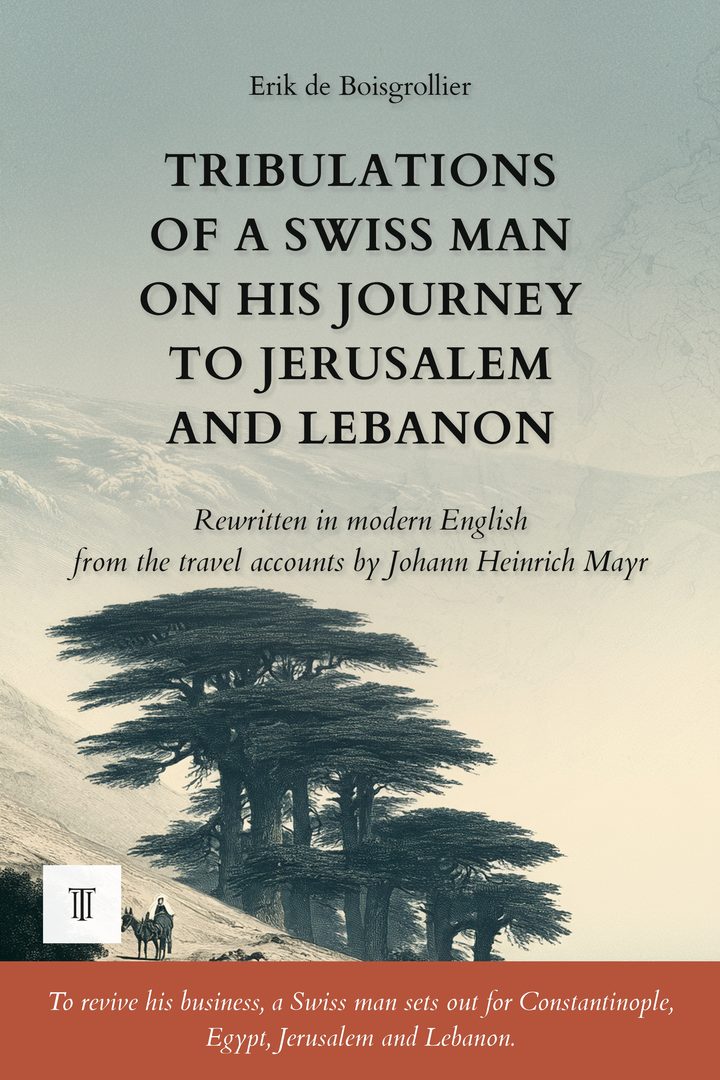
Three years later, with the Continental System paralysing the region's mills, he set out for the East. From May 1812 to early 1814 he travelled down the Danube, reached Constantinople, Egypt, Jerusalem and Mount Lebanon, then returned by way of Salonica and the Balkans. He kept daily notebooks, which his friends urged him to publish. The account appeared in St. Gallen in 1815, from the house of Huber, in six parts and three volumes adorned with aquatints, under the title Schicksale eines Schweizers während seiner Reise nach Jerusalem und dem Libanon. A revised second edition followed in 1820. In his lifetime the book earned him the nickname "Libanon-Mayr", Mayr of Lebanon.
Mayr never sought public office and never joined any society. Yet he kept up a wide correspondence, notably with the painter Angelika Kauffmann, the Zurich writer David Hess, the pastor Johann Conrad Appenzeller and the future Thurgau liberal leader Thomas Bornhauser. A member of the Reformed Church, he felt close to the Moravian Brethren and saw his own life as a pilgrimage. In 1817 he published a pamphlet against the competition of English machines, which he accused of ruining the industry of the Continent.
He never married, and devoted his last years to "Meine Lebenswanderung", a handwritten autobiography of more than three thousand pages, kept alongside a lifelong diary. He died in Arbon on 27 October 1838. His papers are held by the State Archives of Thurgau, and Kurt Buenzli published his autobiography in four volumes in 2010.