Biography
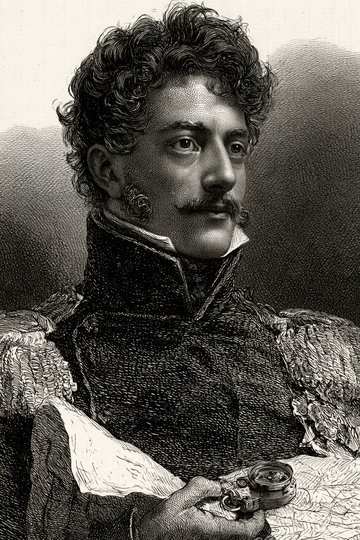
Anton Prokesch was born in Graz on 10 December 1795, into a family of Moravian origin. His early years are poorly documented in the notices consulted: all we know is that he took part in the campaigns against France from 1813 to 1815 and afterwards taught mathematics at a military school, according to English Wikipedia. In Graz, he frequented the salon of Marie Pachler-Koschak.
Having become secretary, then adjutant to Field Marshal Schwarzenberg from 1818, he entered Metternich's orbit. In 1824, a first mission to the Levant, entrusted to him by the Aulic War Council, opened his diplomatic career and made him a familiar of the East. He was ennobled in 1830 as Ritter von Osten, then made a baron in 1845 and a count in 1871. In the meantime, he had been very close to the Duke of Reichstadt, Napoleon's son, between 1830 and 1832.
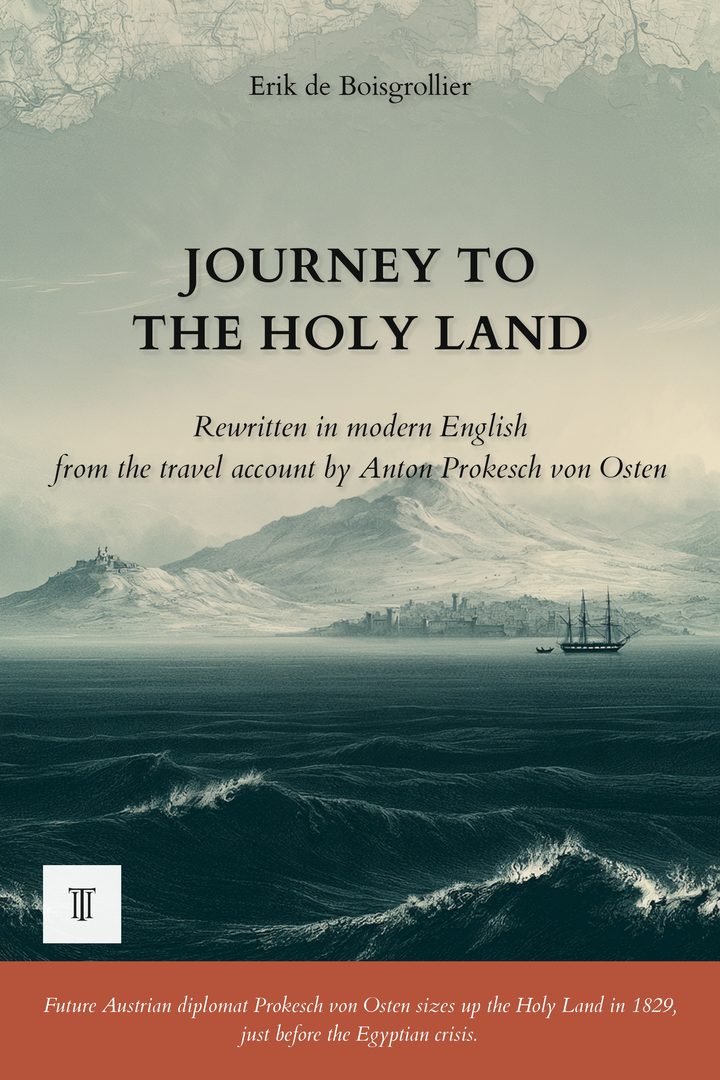
In 1829, Major Prokesch was charged with negotiating with Abdallah, pasha of Acre, an agreement favourable to the Christians of the Holy Land. During this mission, he spent Easter week in Jerusalem, where he was received as a Knight of the Holy Sepulchre. He brought back the Reise ins heilige Land, published in 1831 in Vienna by Carl Gerold and translated into Danish by Christian Winther in 1839. Other books on Egypt, Nubia and Asia Minor followed, among them the Erinnerungen aus Aegypten und Kleinasien (1829 to 1831).
His name remains attached to Austrian diplomacy in the East. In 1833, he contributed to the mediation between Muhammad Ali and Sultan Mahmud II. He was then sent to Athens (1834 to 1849), to Berlin (1849 to 1853), and to Frankfurt to the Federal Diet (1853 to 1855). Internuncio at Constantinople in 1855, he became ambassador there from 1867 to 1871. A philhellene and a supporter of a strong state, he also published a history of the Greek uprising of 1821 (1867), the Kleine Schriften in seven volumes (1842 to 1844) and memoirs on Schwarzenberg. He also collected coins, and the Berlin museum bought his collection in 1875.
In 1832 he married Irene Kiesewetter, a pianist and salon hostess, with whom he had a son and a daughter. Retired in 1871, he died in Vienna on 26 October 1876 and rests in a mausoleum designed by Theophil von Hansen in the St Leonhard cemetery in Graz. A member of the academies of Berlin and Vienna, he left papers divided, according to the Neue Deutsche Biographie, among the Haus-, Hof- und Staatsarchiv in Vienna, the Steiermärkisches Landesarchiv, the Graz university library and the Staatsbibliothek in Berlin. His memoirs and correspondence appeared after his death; Daniel Bertsch's thesis (Oldenbourg, 2005) remains the standard study. The sources consulted report no modern reissue of the Reise ins heilige Land.