Biography
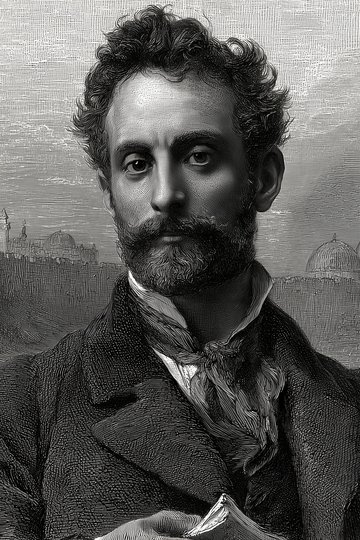
Louis Énault was born in 1824 at Isigny, on the coast of Calvados (a few older notices give 1820, but most catalogues settle on 1824). The young Norman went up to Paris to study law and was admitted as a lawyer. The bar did not hold him for long: he moved in Legitimist circles, loyal to the senior branch of the Bourbons, and that proximity led to his arrest after the June Days of 1848.
Once released, he took to the road. The years that followed were years of departures: northern Europe on one side, the Mediterranean on the other. In 1850 he stayed in Liguria and described the old centre of Genoa in his notebooks. The following year he defended a doctoral thesis in letters on Aeschylus at the University of Caen, the mark of a classical culture he would bring to all his narratives.
Yet it was in the press that he made his career. As a literary and art critic he wrote for Le Figaro, L'Illustration, Le Constitutionnel and La Gazette, sometimes under the pen name Louis de Vernon. Journalism fed his travels and his travels fed his journalism: his travel books appeared at a steady pace. La Terre-Sainte, brought back from the pilgrimage of 1853, came out in 1854; it was followed by books on Constantinople, on Norway (1857), on the Hebrides, and later on Central and South America. His is the eye of a cultivated reporter, alert to landscapes as much as to the political tensions of the moment.
Énault was also a translator. He produced a French version of Goethe's The Sorrows of Young Werther (1855) and, in 1859, a translation of Harriet Beecher Stowe's Uncle Tom's Cabin, then at the height of its fame. In 1876 he wrote the text of Londres, a large book illustrated by Gustave Doré, whose more than one hundred and seventy wood engravings show the industrial capital, its docks and its wretched districts.
Alongside this, he pursued a prolific career as a novelist: La Rose blanche (1857), Christine (1858), La Circassienne (1877) and Le Mirage (1892) mark a steady output, often in the sentimental vein. In 1898 the Académie française awarded him the Prix Juteau-Duvigneaux for Le Rachat d'une âme.
Louis Énault died in Paris on 28 March 1900. Widely read in his lifetime and present in every major newspaper, he was forgotten almost at once: his name meant nothing to the next generation. His travel narratives nonetheless keep the freshness of first-hand testimony, that of a man who watched the East tip towards the Crimean War.