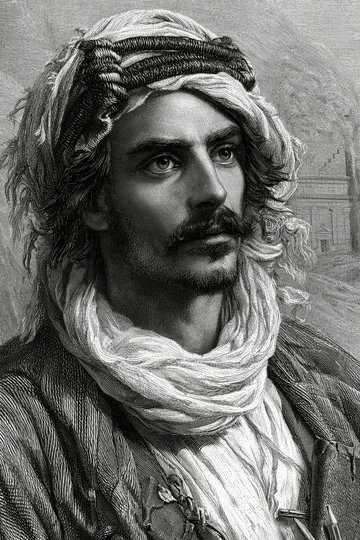
Biography
Léon Emmanuel Simon Joseph de Laborde was born in Paris in June 1807, on the 12th according to the entry in the Deutsche Biographie. He was the only son of Count Alexandre de Laborde, a traveller and author of an Itinéraire descriptif de l'Espagne, and of Thérèse Sabatier de Cabre, and the grandson of the financier Jean-Joseph de Laborde. He grew up in a family where study and travel were taken for granted, and he was educated at the University of Göttingen.
While still very young, he accompanied his father to the East: Italy, Corfu, Constantinople, Asia Minor, Syria, Jerusalem, Alexandria. Along the way he drew a great number of ancient monuments. On his return he entered diplomacy: secretary of embassy in Rome under Chateaubriand in 1828, he resigned with him the following year. After the revolution of 1830 he briefly served as aide-de-camp to La Fayette, then moved to the London embassy under Talleyrand and to the legation in Hesse-Kassel. He later succeeded his father as deputy for Seine-et-Oise, for the constituency of Étampes.
Before diplomacy came the expedition that founded his reputation. In the spring of 1828, with the engineer Linant de Bellefonds, then in the service of Muhammad Ali, he crossed Sinai, reached Aqaba and went up as far as Petra, where the two men were the first Frenchmen to stay. From it he drew the Voyage de l'Arabie Pétrée, a large folio published in Paris by Giard in 1830 and issued until 1833 according to the Encyclopædia Universalis, whose plates reproduce his own drawings. An English translation, Journey through Arabia Petraea to Mount Sinai, made the book known across the Channel.
Laborde then turned to the history of art. He published studies on the beginnings of printing in Strasbourg and Mainz, on mezzotint engraving, on the Renaissance of the arts at the French court, as well as a Commentaire géographique sur l'Exode et les Nombres. Elected to the Académie des inscriptions et belles-lettres in 1842, he became a curator at the Louvre (in 1845 according to the Encyclopædia Universalis, in 1847 according to other entries), then was put in charge of the medieval and Renaissance collections, before leaving in 1854 after conflicts with Nieuwerkerke. His report on the Great Exhibition of 1851 in London argued for the union of the arts and industry.
Appointed director general of the Archives of the Empire in 1857, he had new repositories built, created the Museum of French History at the Hôtel de Soubise and launched the great inventories. Ill, he withdrew in 1868, the year he entered the Senate. He died at the Château de Beauregard, in Fontenay, in the Eure, on 25 or 26 March 1869 depending on the sources. His immense card index of Parisian records, copied before the Hôtel de Ville fire of 1871, was deposited by his son Alexandre at the Bibliothèque nationale in 1926; it remains a major tool for the history of artists.